934 Roman Denarii: Germany's Largest Hadrian-Era Hoard
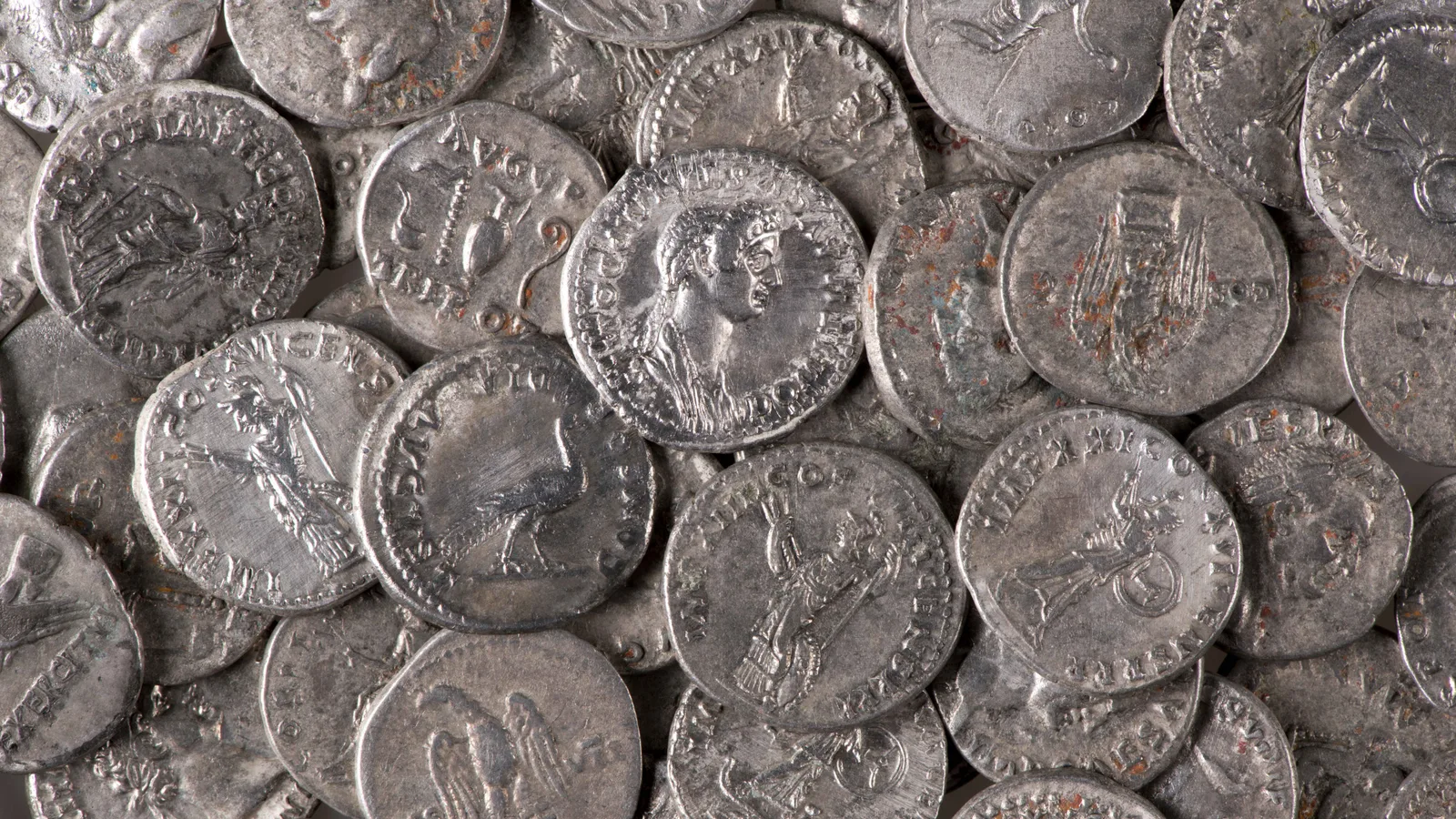
Oliver Riedl had already lifted 15 Roman silver coins from a field near Wesseling, south of Cologne, when his metal detector kept signalling. “It was clear to me that something bigger was lying here,” he said in a statement issued on 22 September by the Rhineland's state archaeology office, the LVR-Amt für Bodendenkmalpflege im Rheinland. “So I notified the office immediately.” Archaeologists from the office's Nideggen field station took over the dig and recovered 934 silver denarii in all — 3.1 kilograms, or 6.8 pounds, of Roman coinage.
Erich Claßen, the state archaeologist who heads the office, called it “the largest coin hoard from this period in Germany; worldwide it is the fifth-largest.” The dating rests on the youngest coin in the group, struck in A.D. 124 or 125, which places the burial in the second quarter of the second century, during Hadrian's reign from 117 to 138. Most of the coins are older, from the Flavian emperors of A.D. 69 to 96, and the oldest was minted in 148 B.C., under the Roman Republic — more than 270 years old when it went into the ground, and still valid money. Spread across 934 pieces, the 3.1 kilograms work out at roughly 3.3 grams of silver a coin.
What the sum meant is easier to state than what it is worth today, a figure nobody has published. Rahel Otte, the office researcher who examined the coins, said a rank-and-file legionary of the period earned 300 denarii a year, of which about half was withheld for food and equipment. “A legionary would therefore have had to save all his disposable income for around six years to accumulate the Wesseling hoard,” she said. Who actually put it together is unknown; the office suggests the owner may have lived on one of the Roman estates nearby.
The hoard was lifted as a single block of earth and taken to the restoration workshop of the LVR-LandesMuseum Bonn, where it was X-rayed before anything was cleaned. Inside were fragments of a ceramic pot and traces of straw, which the office reads as a straw-lined pot that ploughing later destroyed, scattering the coins through the topsoil. Otte said every coin was found and recovered. On the motive, Claßen noted there were no banks then, so someone was probably storing money safely; the open question is why it was never retrieved. One possibility he offered: the owner died before passing on the knowledge.
Metal detecting in North Rhine-Westphalia requires a permit from the heritage authorities, the landowner's consent and training from a specialist office. Under the state's heritage law the find now belongs to the state, and Riedl is to receive a reward from the North Rhine-Westphalia ministry responsible. The hoard is on public display for the first time at the LVR-LandesMuseum Bonn, and is being shown to specialists at the joint conference of the German antiquity research associations, which runs in Bonn from 21 to 25 September with around 300 archaeologists.
Sources
- LVR-Amt für Bodendenkmalpflege im RheinlandPrimary source
- Associated Press / ABC NewsAgency
- Nordwestdeutscher Verband für AltertumsforschungPrimary source
- Global NewsSecondary
- Archaeology MagazineSecondary
Related
Two New Islands Rise by Anak Krakatau After 25-Hour Eruption
New Gut Bacterium C. immunis Cut Visceral Fat in Obese Mice
Third Beluga From 30-Whale Rescue Dies at Chicago's Shedd
Amoeba Breeds at 63°C, Past the 60°C Limit for Complex Life
First Diplodocus Found Outside North America, in Spain
1,200 Gravity Readings Revive King Tut Hidden-Chamber Debate
Stanford Study: Human Brain Grows From Two Separate Origins
Northwestern Study: Disorder Can Make Networks Stabler
Trending now
- Two New Islands Rise by Anak Krakatau After 25-Hour Eruption
- New Gut Bacterium C. immunis Cut Visceral Fat in Obese Mice
- Haaland Passes Ronaldo and Zlatan With 64th Norway Goal
- Meta's 100-Gram VR Glasses Cost $1,299.99, Ship Spring 2027
- Kurihara, 11, One Win From Youngest Asian Games Medal
- Yu Zidi, 13, Wins Third Asian Games Gold in 4:28.56 400 IM
- Anthropic Cuts Opus Costs 40%, OpenAI Answers in an Hour
- Shin Ohashi, 17, Swims 2:04.83 — First Man Under 2:05 in the 200
Comments
No comments yet. Be the first.