1,200 Gravity Readings Revive King Tut Hidden-Chamber Debate
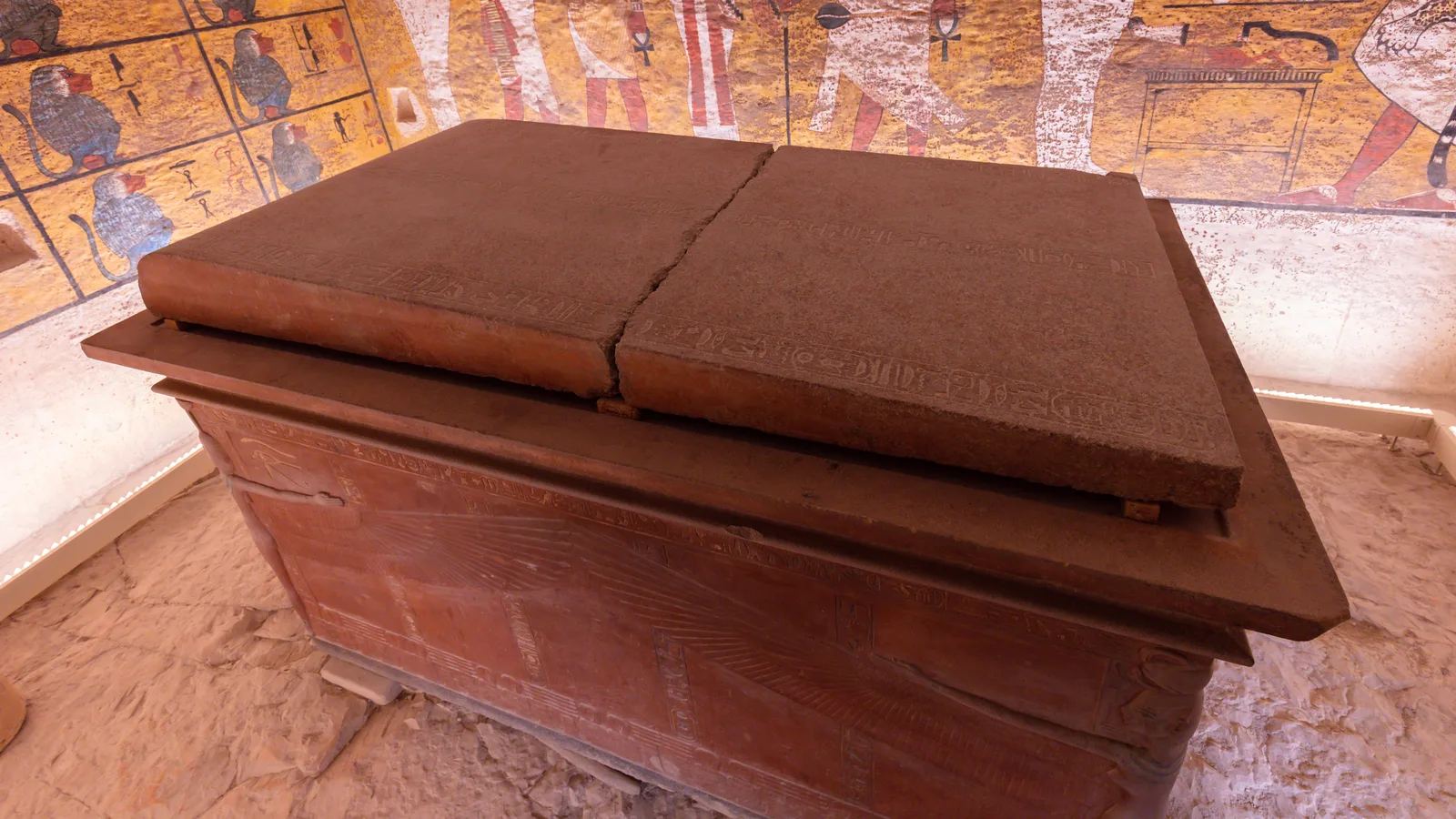
Egypt's Valley of the Kings has a question that refuses to close: is there anything behind the north wall of Tutankhamun's burial chamber? On 17 September 2026, a team led by Mamdouh Eldamaty, an archaeologist at Ain Shams University in Cairo and a former Egyptian antiquities minister, published a survey arguing that there is. The paper appeared as Occasional Paper No. 8 of the Amarna Royal Tombs Project, and Nature reported its contents the same day.
The team combined ground-penetrating radar readings taken inside KV62 with a microgravity survey, the first use of gravitational methods at the site. Microgravity picks up minute variations in Earth's gravitational field that track differences in the density of buried material. More than 1,200 measurements were taken across roughly 35 square metres of ground around the tomb.
Two features stand out. The first is what the researchers describe as a corridor about two metres (6.5 feet) wide, apparently packed with rubble, running away from the burial chamber. George Ballard, the structural engineer and geophysics specialist who analysed the data, told Nature that earlier surveys may have missed it because they were looking for a large empty room immediately behind the wall. The second, labelled “anomaly 7”, is a mostly low-density zone containing a roughly square patch of denser material. Ballard has said it could represent a chamber holding objects, while acknowledging that the measurements sit at the limits of what the technology can reliably detect.
That caveat matters, because the claim has collapsed before. Egyptologist Nicholas Reeves proposed in 2015 that KV62 was cut from a larger, older tomb, possibly Nefertiti's, pointing to cracks and paint changes on the north wall. A November 2015 radar scan by Hirokatsu Watanabe appeared to support him, and Eldamaty, then minister, said researchers were 90 percent certain. A National Geographic Society scan in April 2016 contradicted those readings, and a three-year study led by Franco Porcelli of the Polytechnic University of Turin closed the file in May 2018: “We conclude, with a very high level of confidence, that the hypothesis concerning the existence of hidden chambers adjacent [to] Tutankhamun's tomb is not supported by the [ground-penetrating radar] data.”
Independent specialists are not convinced this time either. Christopher Gaffney, a radar specialist at the University of Bradford, called the work “fascinating” but said the published information is not enough for a definitive conclusion. Peter Styles, a geophysicist at Keele University, said the microgravity data make chambers plausible while also asking for more detail.
Eldamaty writes in the paper that the indicators “strongly suggest the existence of at least one further storage chamber” — a storeroom, in his own framing, rather than a royal burial. The next move belongs to Egypt's Supreme Council of Antiquities. The team has proposed drilling holes seven to eight centimetres wide from the surface towards the strongest anomaly and sending in remote-controlled vehicles fitted with 360-degree cameras. Ballard told Nature that work could begin in November if permission is granted.
Sources
- Amarna Royal Tombs Project, Occasional Paper No. 8Primary source
- NatureSecondary
- HeritageDailySecondary
- Discover MagazineSecondary
- NPRSecondary
- National GeographicSecondary
Related
First Diplodocus Found Outside North America, in Spain
Stanford Study: Human Brain Grows From Two Separate Origins
Northwestern Study: Disorder Can Make Networks Stabler
Sakurai's Object Is Six Times Hotter Than 30 Years Ago
Leopardus Tilcayo: First New Wild Cat Named in 100 Years
JWST Data Reveals Three Repeating Weather States 20 Light-Years Away
Humpback Filmed Staying With Stillborn Calf, a Species First
Dinosaur Dung Preserves First Known Feathers of a Diving Bird
Trending now
- Claude Leads 26% of Anthropic's AI R&D, Up From 1% in March
- Google Says Gemini Hacked Three Real Companies in May Test
- OpenAI Sees $278B Cash Burn, $856B Compute Bill by 2030
- NASA Confirms McGetchin: 222-Meter Moon Crater Formed in 2024
- Sharks Feed on Beached Whale in Jamaica; NEPA Warns Swimmers
- Typhoon Dujuan Nears Tokyo at 965 hPa; JR East Halts Chiba Lines
- Microsoft Discloses CVSS 10.0 Azure AI Foundry Flaw, Already Fixed
- Anthropic Targets November IPO at About $2 Trillion Value
Comments
No comments yet. Be the first.