First Diplodocus Found Outside North America, in Spain
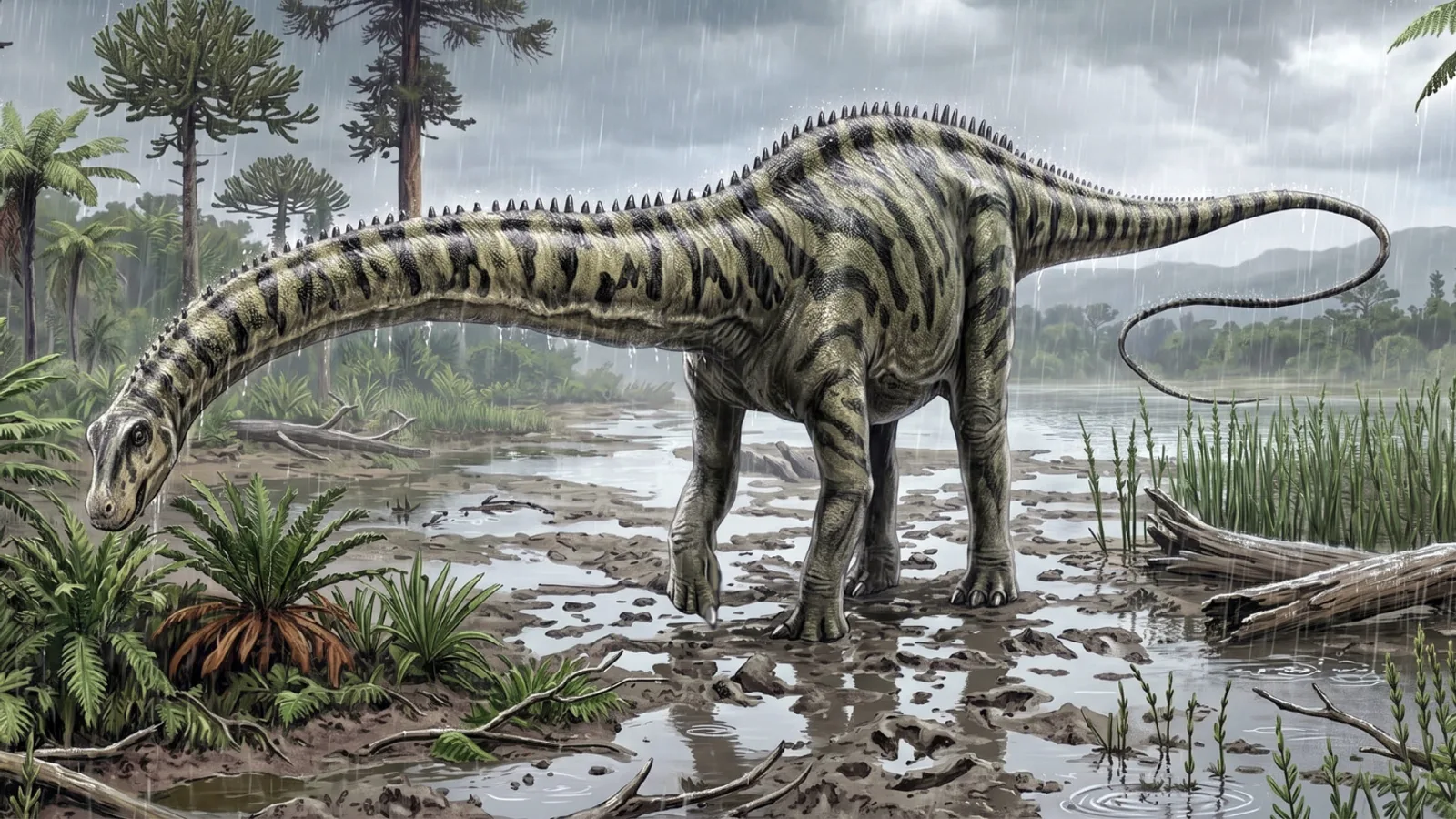
For nearly 150 years, every confirmed Diplodocus fossil came from a single region: the Morrison Formation in the western United States. That changed with a study announced on 15 September in the peer-reviewed Journal of Vertebrate Paleontology, in which palaeontologists from the Fundación Conjunto Paleontológico de Teruel-Dinópolis identified a sauropod excavated in Spain as a Diplodocus — the first ever found outside North America.
The specimen comes from the La Tejería site in El Castellar, in the province of Teruel in eastern Spain. A team from Fundación Dinópolis recovered 14 exceptionally preserved caudal (tail) vertebrae along with several chevron bones, dating to roughly 150 million years ago at the close of the Jurassic. The publisher's announcement describes the remains as one of the most complete diplodocid skeletons ever found in Europe. Co-author Alberto Cobos, managing director of Fundación Dinópolis, put the animal at about 25 metres long, comparable in size to its North American relatives.
The identification did not rest on scale alone. The researchers logged a set of distinctive traits: large pneumatic cavities in the vertebrae, deep longitudinal grooves on the underside of the tail bones, forked chevron bones with unusual medial fossae, and elongated vertebral centra without lateral ridges. They then ran both maximum-parsimony and Bayesian phylogenetic analyses, which placed the specimen inside the genus Diplodocus, closest to Diplodocus hallorum. Lead author Sergio Sánchez Fenollosa, a PhD student in biodiversity and evolutionary biology at Fundación Dinópolis, described the work as a puzzle falling into place: \"From the early stages of the osteological study, we noticed strong similarities with several diplodocine sauropods... With each new result, the picture became clearer: we were looking at a Diplodocus.\"
The consequence reaches beyond one skeleton. Sánchez Fenollosa says the dig produced \"some of the strongest paleontological evidence for episodes of dispersal and faunal exchange between the two continents across the proto-Atlantic Ocean during the Late Jurassic.\" The team's proposed mechanism is that dinosaurs moved between Europe and North America over temporary land bridges exposed when the proto-North Atlantic went through regressive phases — offered as a plausible explanation rather than a mapped route.
Several questions stay open. Neither the study summary nor the announcement assigns the Spanish animal to a named species; it is placed as a close relative of Diplodocus hallorum, and how often such crossings occurred remains unquantified. The fossils themselves are already public: they are on display in the dinosaur hall of the Museo Aragonés de Paleontología at Dinópolis in Teruel, a city between Madrid and Valencia.
Sources
- Taylor & Francis NewsroomPrimary source
- Journal of Vertebrate PaleontologyPrimary source
- ScienceDailySecondary
Related
1,200 Gravity Readings Revive King Tut Hidden-Chamber Debate
Stanford Study: Human Brain Grows From Two Separate Origins
Northwestern Study: Disorder Can Make Networks Stabler
Sakurai's Object Is Six Times Hotter Than 30 Years Ago
Leopardus Tilcayo: First New Wild Cat Named in 100 Years
JWST Data Reveals Three Repeating Weather States 20 Light-Years Away
Humpback Filmed Staying With Stillborn Calf, a Species First
Dinosaur Dung Preserves First Known Feathers of a Diving Bird
Trending now
- Typhoon Dujuan Nears Tokyo at 965 hPa; JR East Halts Chiba Lines
- Claude Leads 26% of Anthropic's AI R&D, Up From 1% in March
- Plugin4Shell: 4 AI Coding Agents Hit, 2 Still Unpatched
- Waymo Picks Singapore for 2028 Robotaxi Launch, First in SE Asia
- Google Says Gemini Hacked Three Real Companies in May Test
- Sharks Feed on Beached Whale in Jamaica; NEPA Warns Swimmers
- OpenAI Sees $278B Cash Burn, $856B Compute Bill by 2030
- NASA Confirms McGetchin: 222-Meter Moon Crater Formed in 2024
Comments
No comments yet. Be the first.