Sakurai's Object Is Six Times Hotter Than 30 Years Ago
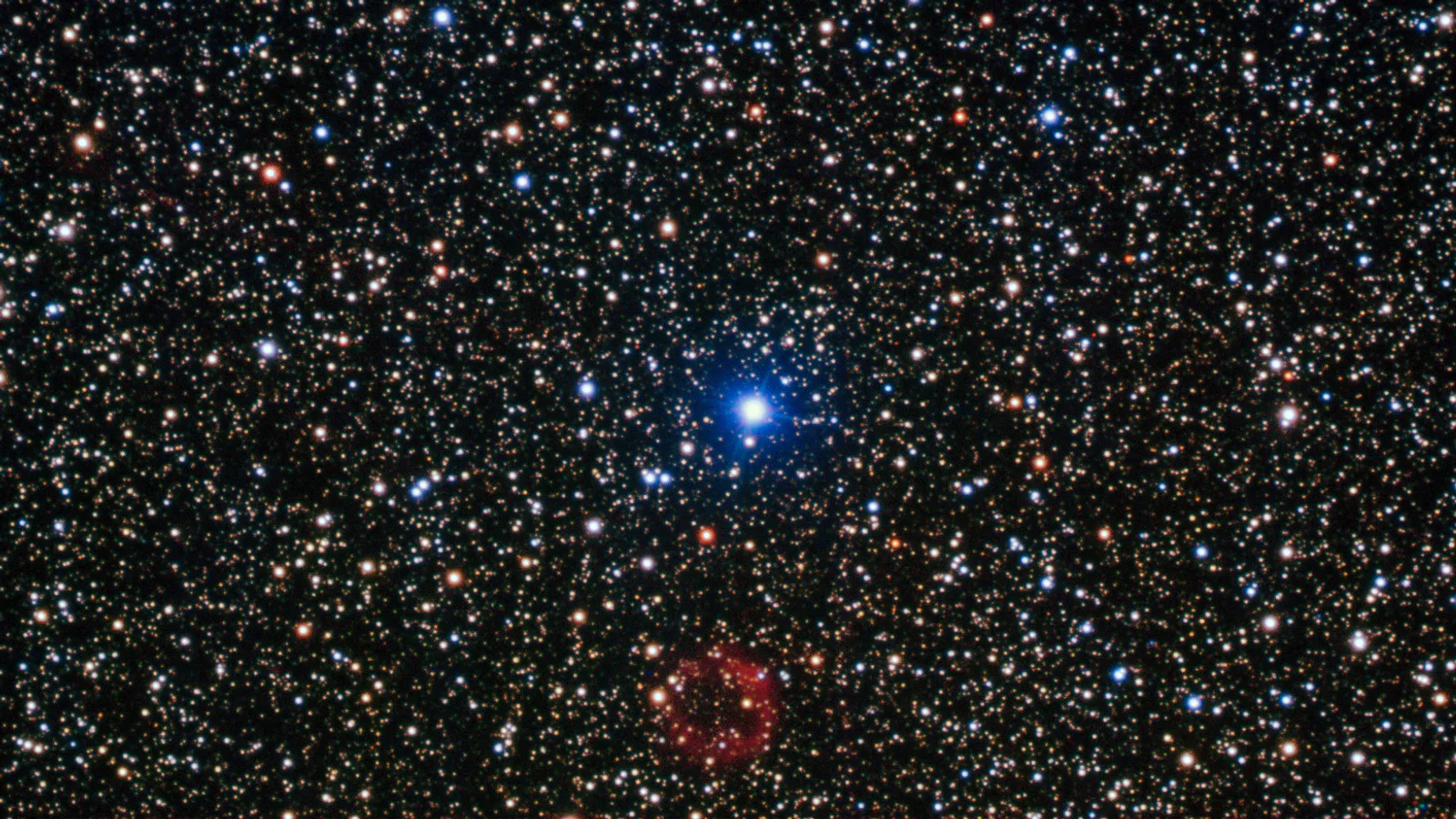
A dead star that unexpectedly flared back to life in 1996 has crossed into a new stage of that revival, according to a study published on 16 September 2026 in Monthly Notices of the Royal Astronomical Society. Using fresh observations from the FORS2 instrument on the European Southern Observatory's Very Large Telescope in Chile, an international team reports the first secure spectroscopic identification of the core of Sakurai's Object as a [WC] star — the carbon branch of Wolf-Rayet-type stars, defined by a fast, carbon-rich wind. The work, led by W. Marcolino of the Valongo Observatory at the Federal University of Rio de Janeiro, puts the star's surface temperature at about 30,500 K. The University of Manchester, whose Jodrell Bank Centre for Astrophysics contributed to the paper, says the star now sits between roughly 27,000 and 36,000 K — about six times hotter than it was 30 years ago, when its surface was close to the Sun's.
Stars almost never do this on a human timetable. Sakurai's Object is a white dwarf that reignited in a helium flash, swelling back into a giant and throwing off gas and dust before it starts shrinking again, as ESO describes the sequence. Only two such “born-again” stars have ever been watched directly: Sakurai's Object, spotted in 1996 by the Japanese amateur astronomer Yukio Sakurai in the constellation Sagittarius, and V605 Aquilae, which erupted roughly 80 years earlier. The new paper measures V605 Aquilae at about 95,000 K — some three times hotter — which turns the pair into a before-and-after picture of the same process. Manchester says ALMA radio images show the material ejected after the 1996 event now spans a region about the size of the Solar System.
“Most stars evolve so slowly that major changes take place over timescales far longer than a human lifetime,” said Professor Albert Zijlstra of the Jodrell Bank Centre for Astrophysics, quoted by Phys.org. That is what makes the temperature figure useful rather than merely striking. The authors report that the value they derive is lower than models predicted if convective mixing is suppressed during the very late thermal pulse that drives the rebirth, and that it fits better with higher-time-resolution calculations for a somewhat lower-mass remnant — below about 0.6 solar masses. Manchester's summary puts it plainly: the star is reheating more gradually than some earlier models expected.
What comes next is measurement rather than speculation. The authors write that continued spectroscopic monitoring and atmospheric modelling will be crucial for tracing the star's reheating curve and pinning down the physics of this rapid evolutionary phase. Neither the paper's abstract nor the Manchester release gives a distance to the object. Whether Sakurai's Object keeps climbing toward the temperature V605 Aquilae has already reached, and how fast, is the open question the next few years of observations are meant to answer.
Sources
Related
First Diplodocus Found Outside North America, in Spain
1,200 Gravity Readings Revive King Tut Hidden-Chamber Debate
Stanford Study: Human Brain Grows From Two Separate Origins
Northwestern Study: Disorder Can Make Networks Stabler
Leopardus Tilcayo: First New Wild Cat Named in 100 Years
JWST Data Reveals Three Repeating Weather States 20 Light-Years Away
Humpback Filmed Staying With Stillborn Calf, a Species First
Dinosaur Dung Preserves First Known Feathers of a Diving Bird
Trending now
- Universal, Sony Sue Suno Again Over 60,202 Recordings
- China's CXMT Starts Mass Production of 11.95nm G5 DRAM
- Alibaba Open-Sources CT AI That Flags 146 Conditions
- First Diplodocus Found Outside North America, in Spain
- Plugin4Shell: 4 AI Coding Agents Hit, 2 Still Unpatched
- 1,200 Gravity Readings Revive King Tut Hidden-Chamber Debate
- $100M of TikTok's Privacy Deal in Doubt as Judge Keeps 2019 Order
- Gane Named Undisputed UFC Champ, Faces Hokit at MSG Nov. 14
Comments
No comments yet. Be the first.