JWST Data Reveals Three Repeating Weather States 20 Light-Years Away
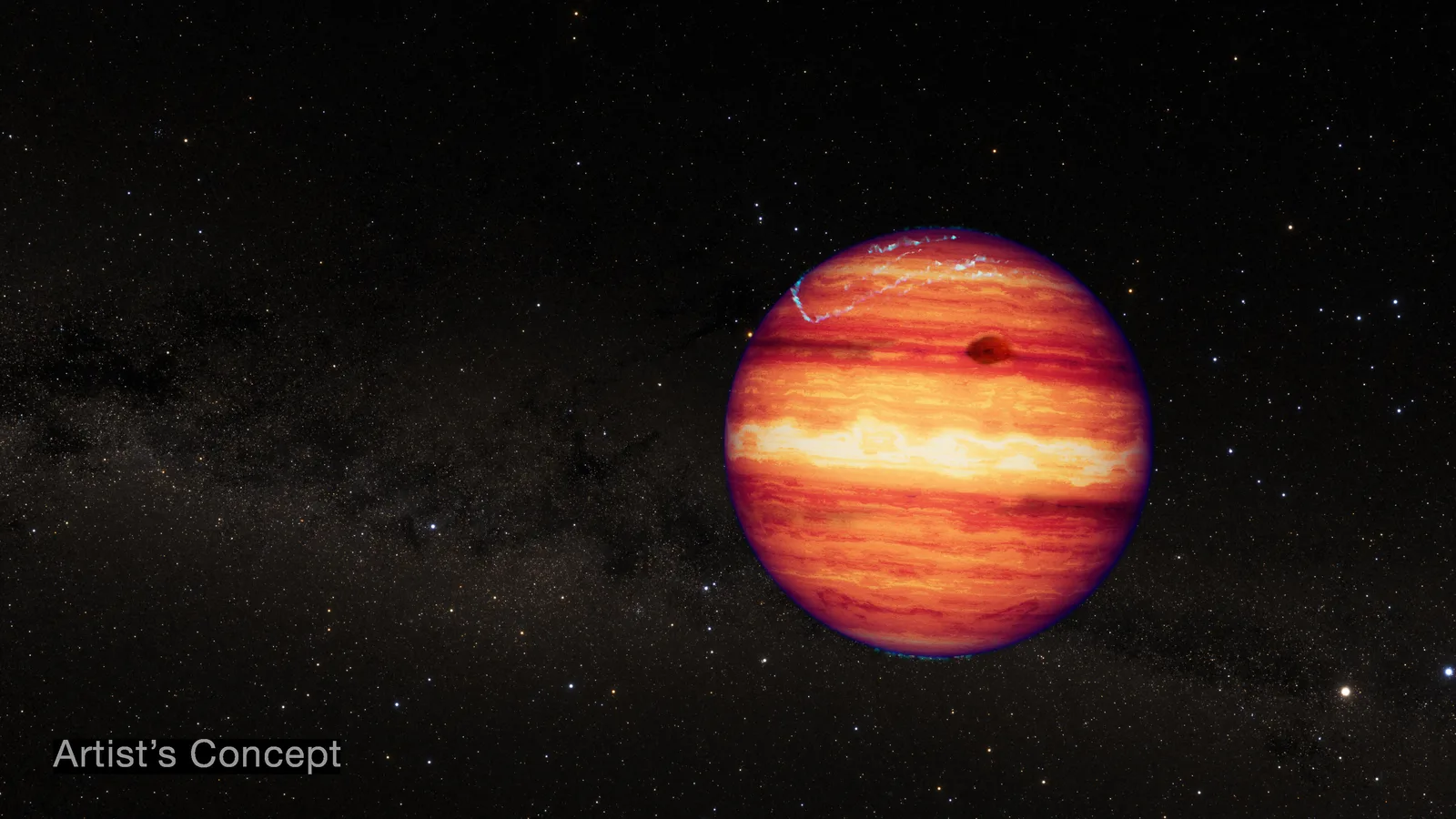
Astronomers say they have worked out what actually drives the weather on SIMP 0136, a Jupiter-like world drifting through space without a star about 20 light-years from Earth. In a study published on 16 September 2026 in the journal Astronomy & Astrophysics, a team led by Trinity College Dublin PhD candidate Merle Schrader reports that the object's constantly shifting brightness is governed by just two dominant processes — changes in temperature and the vertical structure of its clouds — which together produce three recurring weather states.
The result comes from applying Principal Component Analysis, a statistical technique that strips a complex signal down to the handful of components doing most of the work, to light-curve data collected by NASA's James Webb Space Telescope. Instead of building an atmospheric model first and testing the fit afterwards, the method asks the data which variables matter most. Schrader said the team "also discovered that these drivers of the weather patterns on SIMP 0136 persist over time, even as the detailed appearance of the atmosphere evolves over more than a dozen rotations" — the underlying machinery keeps running even as the view changes.
SIMP 0136 is a brown dwarf, sometimes described as a super-Jupiter: it has the bulk and chemistry of a gas giant but orbits no star, so no external sunlight warms its atmosphere. That makes it an unusually clean laboratory, because whatever weather it has must be generated from within. Schrader framed the distance this way: "Light travels at around 300,000 km/s but, even at that speed, it took two decades to reach us, peering through the JWST lenses."
What makes this more than a single-object curiosity is the method. Associate Professor Johanna Vos, a co-author, said the findings "will transform how astronomers analyze future JWST observations," adding that "since our approach rapidly identifies the dominant components of the atmosphere, it offers an efficient first step before we begin computationally intensive modeling." On Vos's account, the appeal is triage: a fast pass that tells researchers which physical processes are worth the expensive simulations, before any telescope time is committed to follow-up.
Plenty remains open. The paper covers SIMP 0136 and nothing else; the team has not published results applying the technique to any other world, so whether the same two-process picture holds for other brown dwarfs — or for planets that do orbit stars — is untested. It is also not yet established whether a three-state pattern is typical or peculiar to this object. The study carries DOI 10.1051/0004-6361/202660109, and the practical test of Vos's claim will be whether other groups can reproduce the approach on different targets already sitting in the JWST archive.
Sources
- Trinity College Dublin / EurekAlertPrimary source
- Astronomy & Astrophysics (DOI 10.1051/0004-6361/202660109)Primary source
- Phys.orgSecondary
Related
First Diplodocus Found Outside North America, in Spain
1,200 Gravity Readings Revive King Tut Hidden-Chamber Debate
Stanford Study: Human Brain Grows From Two Separate Origins
Northwestern Study: Disorder Can Make Networks Stabler
Sakurai's Object Is Six Times Hotter Than 30 Years Ago
Leopardus Tilcayo: First New Wild Cat Named in 100 Years
Humpback Filmed Staying With Stillborn Calf, a Species First
Dinosaur Dung Preserves First Known Feathers of a Diving Bird
Trending now
- Universal, Sony Sue Suno Again Over 60,202 Recordings
- China's CXMT Starts Mass Production of 11.95nm G5 DRAM
- Alibaba Open-Sources CT AI That Flags 146 Conditions
- First Diplodocus Found Outside North America, in Spain
- Plugin4Shell: 4 AI Coding Agents Hit, 2 Still Unpatched
- 1,200 Gravity Readings Revive King Tut Hidden-Chamber Debate
- Microsoft Discloses CVSS 10.0 Azure AI Foundry Flaw, Already Fixed
- $100M of TikTok's Privacy Deal in Doubt as Judge Keeps 2019 Order
Comments
No comments yet. Be the first.