Dinosaur Dung Preserves First Known Feathers of a Diving Bird
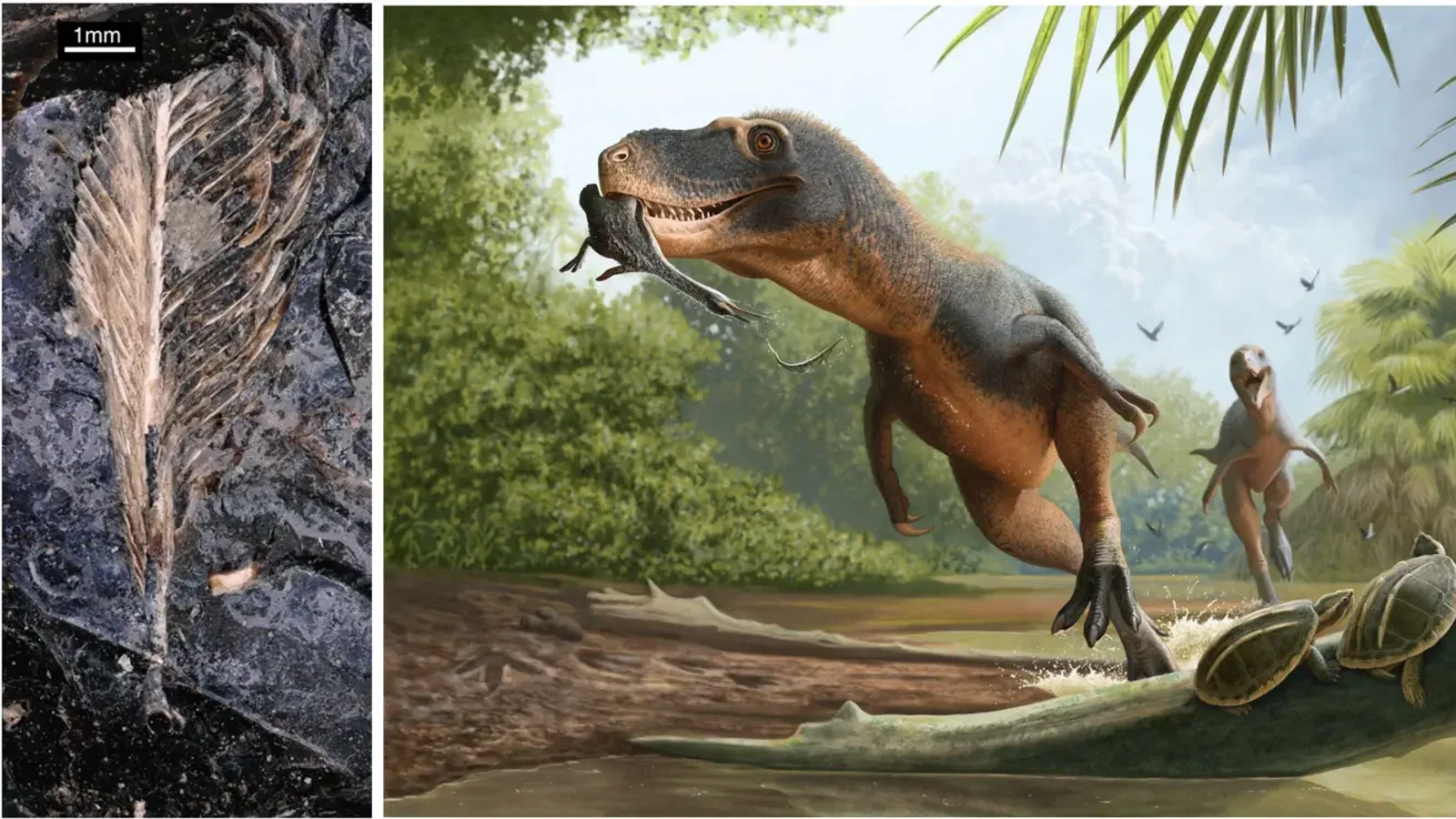
A fossilised dropping about half the size of a golf ball, collected in 2016 from the Hell Creek Formation in northeastern Montana, has turned out to hold feathers from an extinct diving bird. Writing in Current Biology on September 10, 2026, researchers describe multiple feather fragments inside the coprolite, along with the scales of a gar and the leg bones of a hesperornithiform — a largely flightless bird that chased fish underwater, much as a loon does today. The Field Museum, where lead author Jingmai O'Connor is associate curator of fossil reptiles, says these are the first hesperornithiform feathers ever found. The animal that produced the dropping has not been identified: the museum describes a large predator, "maybe a T. rex or a Nanotyrannus," and the team does not settle on a species.
The fossil spent close to a decade in collections before the analysis was published. David DeMar Jr., a palaeontologist with the University of Washington's Burke Museum, collected it in the field in 2016. To read its contents without destroying it, the team examined the specimen's mineral composition and took CT scans. The Field Museum and the University of Washington each published announcements the same day. The author list spans several institutions and includes O'Connor, DeMar, Gregory Wilson Mantilla of the University of Washington and the Burke Museum, Nate Carroll of the Carter County Museum in Ekalaka, Montana, and Karen Chin of the University of Colorado Boulder.
What makes the plumage notable is that it is mixed rather than uniform. According to the University of Washington, two of the feathers — including the one exposed at the surface of the coprolite — carry features otherwise seen only in living birds and their immediate ancestors, among them a square feather shaft with a sponge-like centre; no other Mesozoic feather is known to combine those traits. Other feathers from the same bird are smaller, fuzzy and primitive, of the kind associated with earlier dinosaurs. The university calls them the best-preserved fossil feathers known from the Mesozoic. That bears on a stubborn question: why the extinction 66 million years ago was selective, wiping out whole bird lineages while the ancestors of today's birds came through. O'Connor's hypothesis is that the types of feathers these birds had, or the way they moulted them, was one of the underlying causes of that selectivity — plumage less able to hold body heat would have been a liability in the cold that followed the asteroid impact.
That remains a hypothesis rather than a settled explanation. A single coprolite records the plumage of one bird, not of every Cretaceous lineage, and the researchers do not claim that feathers alone decided which groups survived. The predator's identity is unresolved, and testing the broader argument will take more material: more coprolites, more feather fragments, and comparisons across a wider range of Cretaceous birds. What the find delivers in the meantime is a physical sample of what a hesperornithiform's plumage actually looked like.
Sources
Related
2,884 Supernovae Favour Changing Dark Energy at 3.3 Sigma
Chandra Archive Yields 84 'Hypersoft' X-Ray Sources in 6 Galaxies
Landsat 8 Image Confirms Mount Michael's Persistent Lava Lake
Manhattan-Size Iceberg Survives Greenland Crash
World's Biggest Dark Matter Detector Spots Mystery Particle
New Simulations: Moon May Have Formed in Just 5 Hours
Dark matter hunt sees one puzzling particle — not proof yet
Fusion Reactor 'Flaw' Found to Suppress Turbulence
Trending now
- Fake IT Helpdesk Calls Defeat Passkey Logins, Microsoft Says
- Zverev Beats Shelton in 4 Sets for First US Open Title
- VW Mission Efficiency Sets 0.158 Cd World Record
- Marvel's Wolverine Lands on PS5 With a 77 Metascore
- Revolut Breach: Attackers Demanded 10,000 Bitcoin Ransom
- Saudi Pipeline Repairs to Take Weeks as Brent Tops $107
- Treasury Yield Tops 5.014%, Highest Since 2023, Then Retreats
- US Diesel Sets Record $6.23 a Gallon, AAA Figures Show
Comments
No comments yet. Be the first.