Alibaba Open-Sources CT AI That Flags 146 Conditions
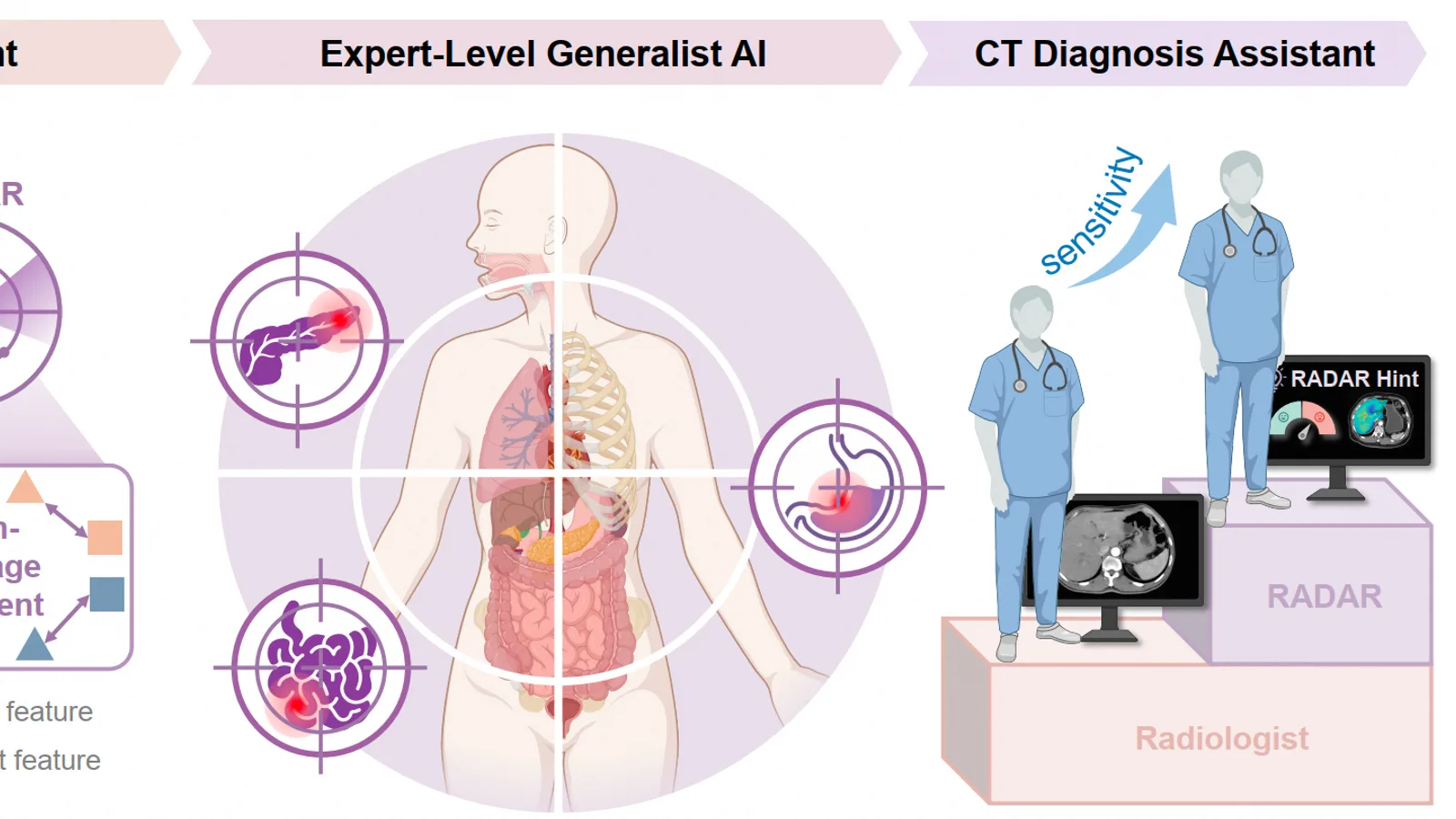
Alibaba's research arm, DAMO Academy, said on September 18 that it has open-sourced RADAR, a vision-language model that reads a single contrast-enhanced abdominal CT scan and flags 146 imaging findings — including malignant tumours — across 18 anatomical structures. The underlying study, "An expert-level generalist AI for abdominal CT diagnosis," appears in Science, volume 393, issue 6817, dated September 17, 2026.
Radiology AI has mostly been built one disease at a time: a model for liver lesions, another for pancreatic masses, each trained on hand-labelled data and blind to anything outside it. RADAR was built differently. According to the paper's abstract, it was trained on more than 400,000 contrast-enhanced abdominal CT examinations and 15 million anatomy-wise image-text pairs, learning directly from the clinical reports radiologists had already written, without manual annotation. The South China Morning Post reported that across nearly 40,000 real-world examinations the model averaged an area under the curve of 0.913 over 146 clinical findings, on a scale where 1.0 is perfect. The research team called it "the world's first expert-level generalist medical imaging model."
The number that matters clinically is not the model working alone but the model working alongside a doctor. In the reader study summarised in the paper, RADAR's assistance increased the diagnostic sensitivity of 26 radiologists by about 10%. TechTimes reported that RADAR's mean diagnostic accuracy exceeded that of 23 of those 26 physicians, and that reading time per case fell by more than 30% when they worked with it. The authors conclude that generalist AI "can match human experts in general and complicated radiology tasks."
The release is free in a specific, limited sense. The code is published on GitHub under the Apache 2.0 licence; the model weights are on Hugging Face under CC BY-NC-SA 4.0, which permits research use but not commercial deployment without a separate agreement.
Several limits are unresolved. RADAR is a research release and a peer-reviewed result, not an approved medical device: it carries no FDA, CE or Chinese regulatory clearance, and is not authorised for clinical diagnosis. Its validated scope is one protocol — contrast-enhanced abdominal CT — so plain-film X-rays, brain MRI and non-contrast studies are outside it. TechTimes also noted the training scans came predominantly from Chinese clinical centres, primarily in Zhejiang Province, leaving performance on other patient populations untested. DAMO senior algorithm expert Zhang Ling said the organ-level training method is not inherently limited to the abdomen or to CT and could extend to chest CT, brain MRI and retinal imaging, TechTimes reported; that expansion has not happened yet.
Disclosure: NewUJ's editorial process uses Anthropic's Claude models.
Sources
- Science — An expert-level generalist AI for abdominal CT diagnosisPrimary source
- GitHub — alibaba-damo-academy/damo-radarPrimary source
- Hugging Face — radar-generalist/RADARPrimary source
- South China Morning PostSecondary
- TechTimesSecondary
Related
Claude Leads 26% of Anthropic's AI R&D, Up From 1% in March
Universal, Sony Sue Suno Again Over 60,202 Recordings
Claude Sped Up 30+ Biology Models 4x, $1M Protein Contest Opens
King Charles to AI Leaders: Control 'Before It Is All Too Late'
Google Home Opens to Claude and Other AI Agents, Not Just Gemini
Huawei's 4,096-Chip AI System Replaces 48,000 Optical Modules
Anthropic Merges Cowork Into Claude, Adds Docs and Slides
OpenAI Reports 6 Cases of Models Hiding Errors, Faking Data
Trending now
- Claude Leads 26% of Anthropic's AI R&D, Up From 1% in March
- Google Says Gemini Hacked Three Real Companies in May Test
- OpenAI Sees $278B Cash Burn, $856B Compute Bill by 2030
- NASA Confirms McGetchin: 222-Meter Moon Crater Formed in 2024
- Sharks Feed on Beached Whale in Jamaica; NEPA Warns Swimmers
- Typhoon Dujuan Nears Tokyo at 965 hPa; JR East Halts Chiba Lines
- Microsoft Discloses CVSS 10.0 Azure AI Foundry Flaw, Already Fixed
- Anthropic Targets November IPO at About $2 Trillion Value
Comments
No comments yet. Be the first.