Two New Sea Spiders Found in the Salish Sea After a Century
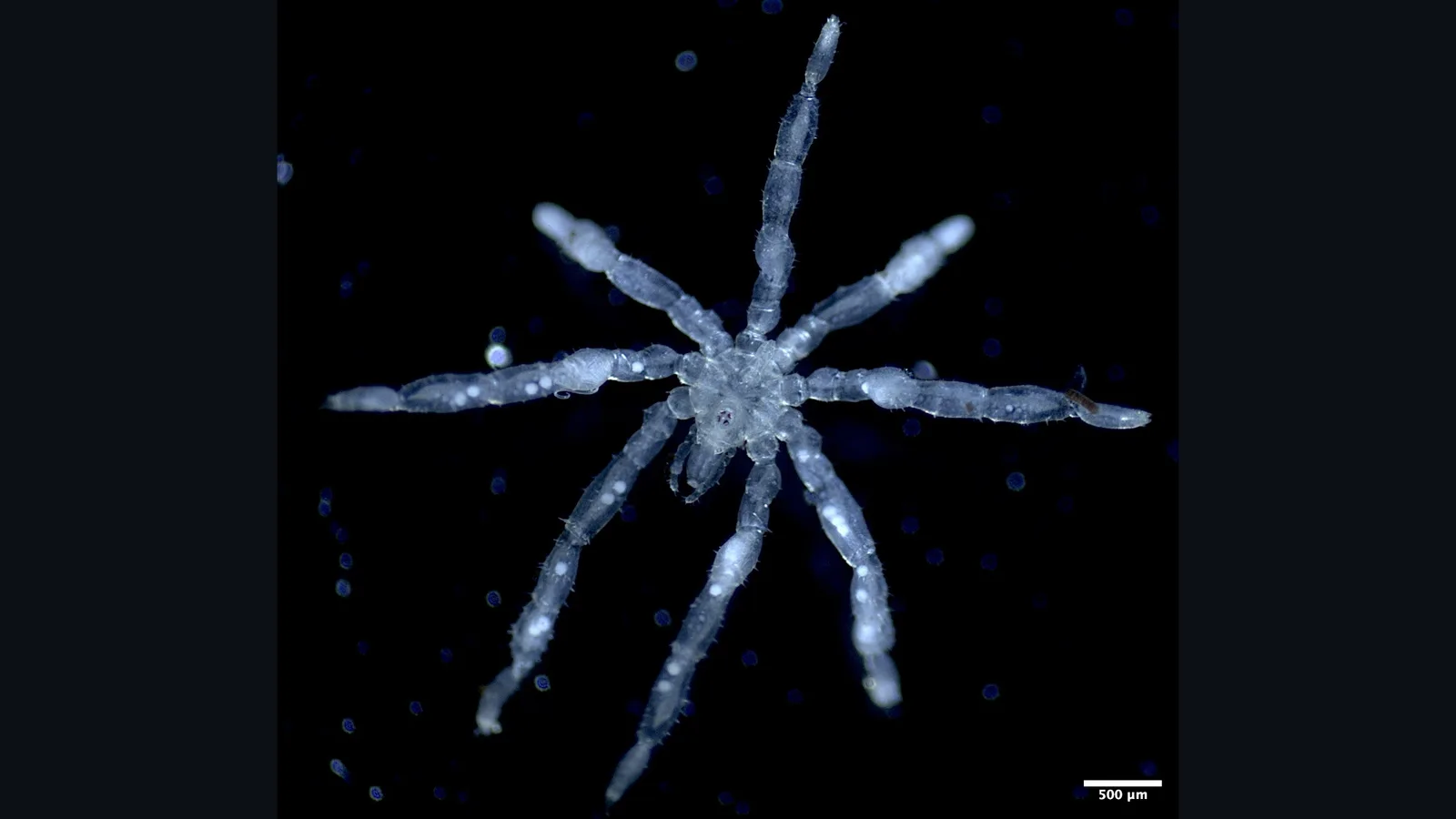
Researchers at the University of British Columbia have formally described two new species of sea spider from the Salish Sea, the stretch of coastal water between Vancouver Island and the mainland of British Columbia and Washington. They are the first new sea spiders described from those waters in nearly a century, UBC said in an announcement published on 23 September. The study appeared in the journal Organisms Diversity & Evolution on 26 August.
The first, Callipallene pilosuspedes, is named for the long curved spines covering its lower legs - a play on the Latin for "hairy feet". It has red eyes, a short proboscis tipped with claws that grasp food before biting, and a triangular, three-lipped mouth covered in sensory tendrils. Under the microscope the team watched it wrap its egg-carrying limbs, called ovigers, around its own legs and clean itself with comb-like spines. Only a single specimen of it was found.
The second, Tanystylum kiixin, is named after an ancient Indigenous village site near where it was first collected. Pronounced "kee-hin", the word comes from the sound of waves breaking at the base of the village site. Its ovigers are much smaller and less dexterous, leaving it unable to groom itself effectively, and researchers repeatedly found it carrying tiny protist parasites of its own - what lead author Cormac Toler-Scott called "an ecosystem within an ecosystem within an ecosystem".
Both animals came from one field season. Specimens were collected between September 2023 and August 2024 on dives of up to 18 metres off Quadra Island, Vancouver, Bamfield and Victoria. A single year of diving at four sites produced two species that nobody had added to the Salish Sea list in close to a hundred years - and the difference between the two comes down to one body part: the pair with the smaller, clumsier ovigers is the pair found covered in parasites.
Sea spiders are arthropods that arose roughly 500 million years ago and never left the ocean. They are related to spiders, scorpions and horseshoe crabs but can carry as many as 12 legs, breathe through their skin, and leave the rearing of young to the males, who glue clusters of eggs to their own bodies. Species range from under a centimetre to more than 70 centimetres in Antarctica.
Toler-Scott, who did the work for his master's degree in zoology, said the gap in the record was the reason he started. "I was interested in how sea spiders are impacted by climate change and human disturbance, because marine invertebrates in the Salish Sea are particularly at-risk, and I couldn't find anything," he said. The paper is the first study of the region's sea spiders to combine detailed imaging with DNA analysis; it covers seven coastal species and produced genetic data for several that had never been sequenced. More are expected. "I only had one field season but there's definitely more diversity out there that we haven't documented," Toler-Scott said.
Sources
- UBC NewsPrimary source
- Organisms Diversity & Evolution (Springer)Primary source
- ScienceDailySecondary
Related
Two New Islands Rise by Anak Krakatau After 25-Hour Eruption
New Gut Bacterium C. immunis Cut Visceral Fat in Obese Mice
934 Roman Denarii: Germany's Largest Hadrian-Era Hoard
Third Beluga From 30-Whale Rescue Dies at Chicago's Shedd
Amoeba Breeds at 63°C, Past the 60°C Limit for Complex Life
First Diplodocus Found Outside North America, in Spain
1,200 Gravity Readings Revive King Tut Hidden-Chamber Debate
Stanford Study: Human Brain Grows From Two Separate Origins
Trending now
- Crew-13 Targets 7-Hour, 50-Minute Trip to the ISS on Oct. 1
- Puripol Boonson Runs 9.90 to End Thailand's 48-Year 100m Wait
- Hyundai, Kia, Genesis EV Owners Sue Over Twice-Recalled ICCU
- DeepMind AGI Safety Researcher Quits, Turns Down Anthropic, OpenAI
- Google Says Gemini Hacked Three Real Companies in May Test
- Zhang Zhanshuo, 19, First Swimmer With 7 Golds at One Asian Games
- Dinosaur Dung Preserves First Known Feathers of a Diving Bird
- Diller Drops $18B MGM Bid; Stock Falls 9.5% to February Levels
Comments
No comments yet. Be the first.