Rocket Lab Protests NASA's $700M Mars Orbiter Award to Blue Origin
Rocket Lab said on September 11, 2026 that it had filed a formal bid protest with the U.S. Government Accountability Office (GAO) over NASA's decision to award the Mars Telecommunications Network (MTN) to Blue Origin. NASA announced the selection on September 1, 2026, in a firm-fixed-price contract with a maximum potential value of roughly $700 million covering the design, development, integration, launch and operation of the network, according to the agency's own news release.
Rocket Lab made its case in a post on X. NASA's "award decision appears to be inconsistent with the eligibility criteria mandated by Congress," the company wrote, adding that the agency's "punitive review of Rocket Lab's technical volume was inconsistent, making incorrect assertions and conclusions." It continued: "Procurement standards exist to ensure fair competition and protect public investment. We are pursuing this review to ensure those standards are upheld for critical infrastructure that will underpin American exploration at Mars for decades to come." Those are Rocket Lab's characterizations of NASA's evaluation, not the findings of any reviewing body.
The protest lands on a schedule with little slack in it. Congress appropriated the $700 million for the orbiter in July 2025 and NASA issued its request for proposals in May 2026, according to Space.com, which reported that Blue Origin and Rocket Lab were widely seen as the front-runners. NASA's release requires the spacecraft — a single orbiter, despite the word "network" in the program's name — to be delivered no later than December 31, 2028, with operations at Mars expected by 2030.
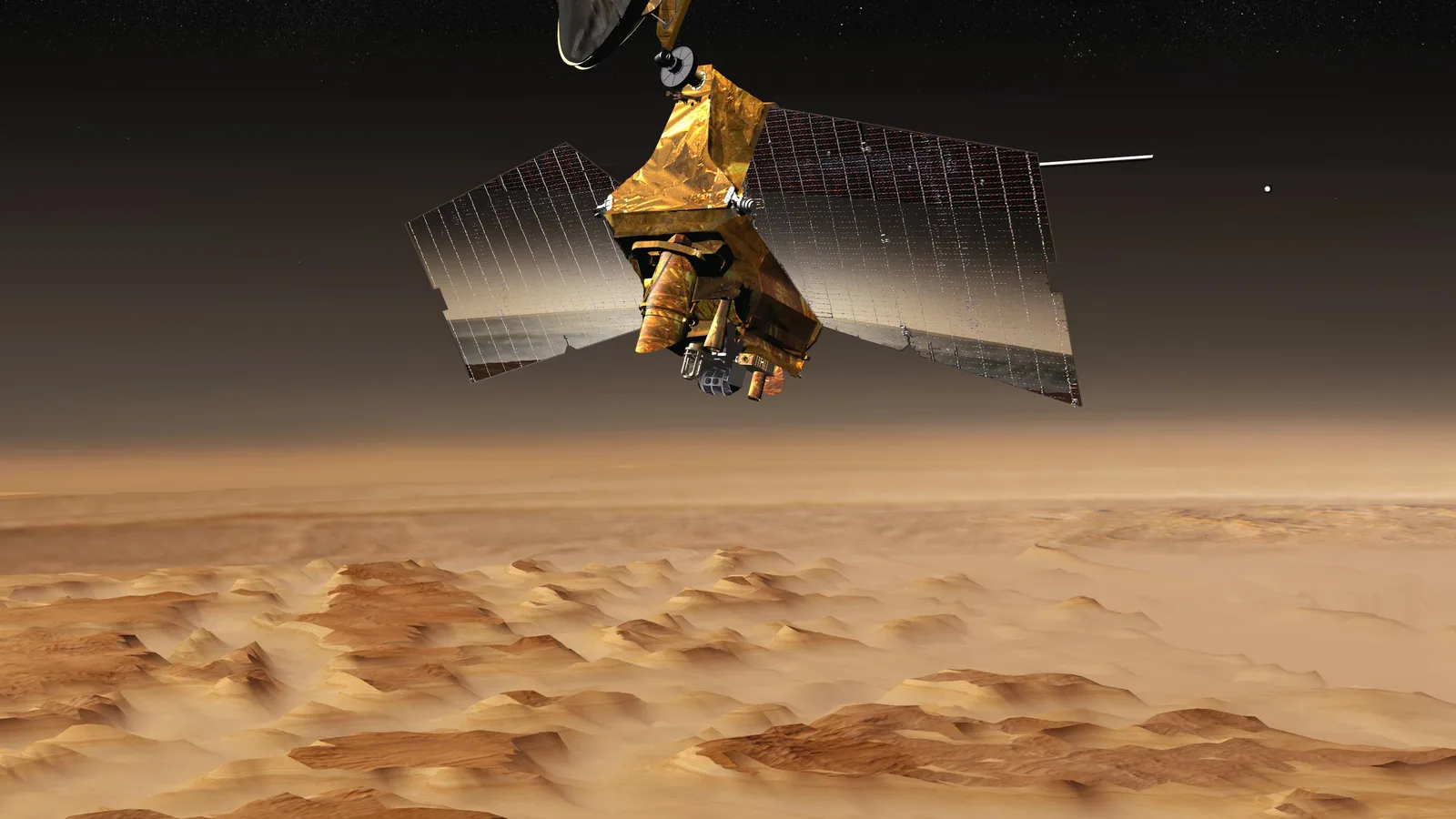
What rides on the outcome is the data link itself. NASA describes the MTN spacecraft as carrying science data, imagery, navigation information and mission communications for vehicles operating on and around Mars. That traffic runs today over two veteran orbiters, according to Space.com: Mars Odyssey and the Mars Reconnaissance Orbiter. NASA's own mission pages date their launches to April 7, 2001 and August 12, 2005 respectively, and describe Odyssey's relay link as the first leg of a communications bridge back to Earth.
There is a role reversal in the file as well. Blue Origin filed its own GAO protest in 2021 after NASA picked SpaceX to build the first crewed lander for the Artemis program. GAO denied that protest in July 2021, Blue Origin then sued NASA and lost in court in November 2021, and the company won a second Artemis lander contract in 2023.
How GAO will rule is the open question. The office says it must decide a protest within 100 calendar days, which for a September 11 filing falls on December 20, 2026. No decision has been issued, and the protest record is not public.
Sources
- NASAPrimary source
- U.S. Government Accountability OfficePrimary source
- NASA Science — Mars Reconnaissance OrbiterPrimary source
- Space.comSecondary
- Via SatelliteSecondary
Related
SpaceX's 700th Falcon Flight Completes SES's 13-Satellite Net
German Rocket Reaches Orbit From European Soil
BepiColombo Begins Mercury Arrival After 8-Year Journey
NASA Gives Blue Origin $700M Contract for Mars Orbiter
Nonprofit's AI-Designed Probe to Launch Toward Alpha Centauri
NASA's Meir, ESA's Adenot Complete ISS Spacewalk
NASA's Roman Space Telescope Launches to L2
Deep Partial Lunar Eclipse Paints Moon Blood-Red
Trending now
- Fake IT Helpdesk Calls Defeat Passkey Logins, Microsoft Says
- Zverev Beats Shelton in 4 Sets for First US Open Title
- VW Mission Efficiency Sets 0.158 Cd World Record
- Marvel's Wolverine Lands on PS5 With a 77 Metascore
- Revolut Breach: Attackers Demanded 10,000 Bitcoin Ransom
- Saudi Pipeline Repairs to Take Weeks as Brent Tops $107
- US Diesel Sets Record $6.23 a Gallon, AAA Figures Show
- Treasury Yield Tops 5.014%, Highest Since 2023, Then Retreats
Comments
No comments yet. Be the first.