Elias 2-24 b Confirmed as Youngest Planet, Under 1 Million Years
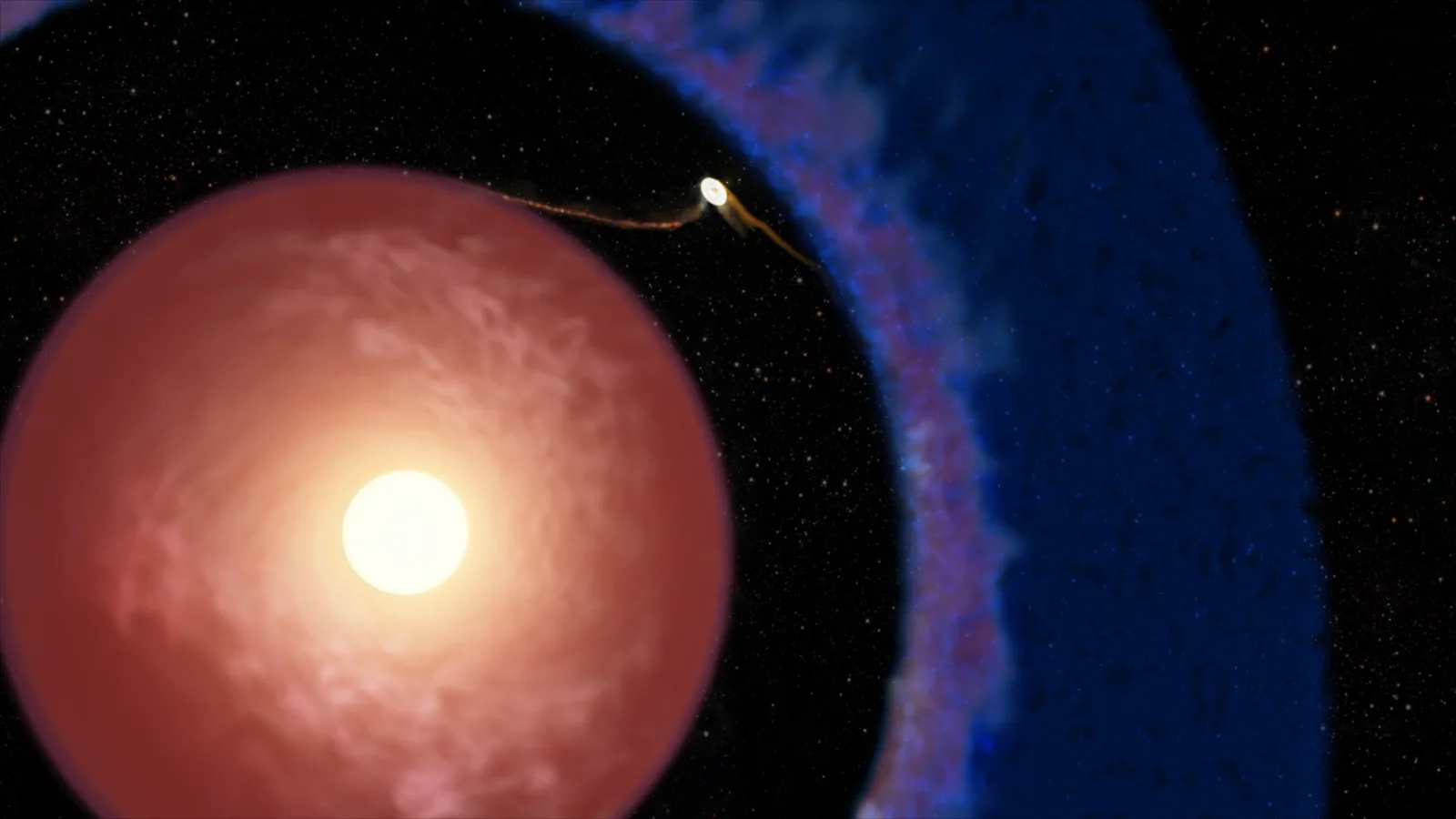
Astronomers have confirmed a world less than a million years old as the youngest planet ever found. Called Elias 2-24 b, it is roughly as massive as Jupiter, still embedded in the disk of gas and dust it formed from, and circles a young star about 450 light-years from Earth. NASA published the confirmation on 16 September 2026, the day the study appeared in The Astrophysical Journal Letters.
The point of light itself is not new. About a decade ago the ALMA array in Chile revealed a gap in the star's dusty disk, and the European Southern Observatory's Very Large Telescope later spotted a faint dot sitting inside that gap. What was missing was proof the dot was a planet rather than an imaging artefact or a background star. A team led by Andrea Bernardi, a doctoral candidate at Chile's Universidad Diego Portales, went back to the NASA-funded Keck Observatory Archive and found the same object in coronagraph observations from 2018 and 2020. Stitching those epochs together let the team track its motion over time, and it moved like a planet orbiting the star.
The record it breaks is not a narrow one. "Our planet-formation models already struggled to explain the previous record holders for the youngest known planet — a four-way tie between two planets orbiting the star PDS 70 and two planets orbiting the star WISPIT 2 — which are all more than 5 million years old," said Lucas Cieza, a professor at the Instituto de Estudios Astrofísicos in Chile and a co-author of the paper. Current models need roughly 5 million years to assemble a Jupiter-size planet at Jupiter's distance from the Sun, and longer farther out. Elias 2-24 b sits about 55 times the Earth-Sun distance from its star — some ten times farther out than Jupiter — and appears to have got there in under a million years.
Where it was found, though, fits theory neatly. "The planets should be found within the gaps, since they are carving them," Bernardi said. "And that's exactly where we found Elias 2-24 b." NASA's description of the system says material is actively accreting onto the Jupiter-mass planet inside a prominent disk gap, supporting the leading core-accretion account of how giant planets come together. The location matches the theory; the clock does not.
Exactly how the planet grew so fast is unresolved. Cieza says the result shows that even the best models are "still missing some important processes." The detection also sits at the edge of what current instruments can do: of the roughly 6,000 confirmed exoplanets, the overwhelming majority are billions of years old and orbit close to their stars, because thick dust hides the young ones. Bernardi points to NASA's Nancy Grace Roman Space Telescope, launched on 30 August, whose more powerful coronagraph should make such detections easier and could reach true Jupiter analogues in tighter orbits.
Sources
- NASA SciencePrimary source
- The Astrophysical Journal Letters (Bernardi et al., doi:10.3847/2041-8213/ae9bb6)Primary source
- ScienceDailySecondary
Related
NASA: Roman Telescope Has Fuel for 22 Years, Not 10
NASA Awards SpaceX $946M for Three More ISS Crew Flights
NASA Confirms McGetchin: 222-Meter Moon Crater Formed in 2024
USSF-259: Third Classified Space Force Launch in a Month
Study: Tides Alone Could Explain Why Venus Has No Moon
NASA: Roman Telescope Has Fuel for at Least 22 Years
SpaceX's 700th Falcon Flight Completes SES's 13-Satellite Net
Rocket Lab Protests NASA's $700M Mars Orbiter Award to Blue Origin
Trending now
- Claude Leads 26% of Anthropic's AI R&D, Up From 1% in March
- Google Says Gemini Hacked Three Real Companies in May Test
- OpenAI Sees $278B Cash Burn, $856B Compute Bill by 2030
- NASA Confirms McGetchin: 222-Meter Moon Crater Formed in 2024
- Sharks Feed on Beached Whale in Jamaica; NEPA Warns Swimmers
- Typhoon Dujuan Nears Tokyo at 965 hPa; JR East Halts Chiba Lines
- Microsoft Discloses CVSS 10.0 Azure AI Foundry Flaw, Already Fixed
- Anthropic Targets November IPO at About $2 Trillion Value
Comments
No comments yet. Be the first.