Study: Tides Alone Could Explain Why Venus Has No Moon
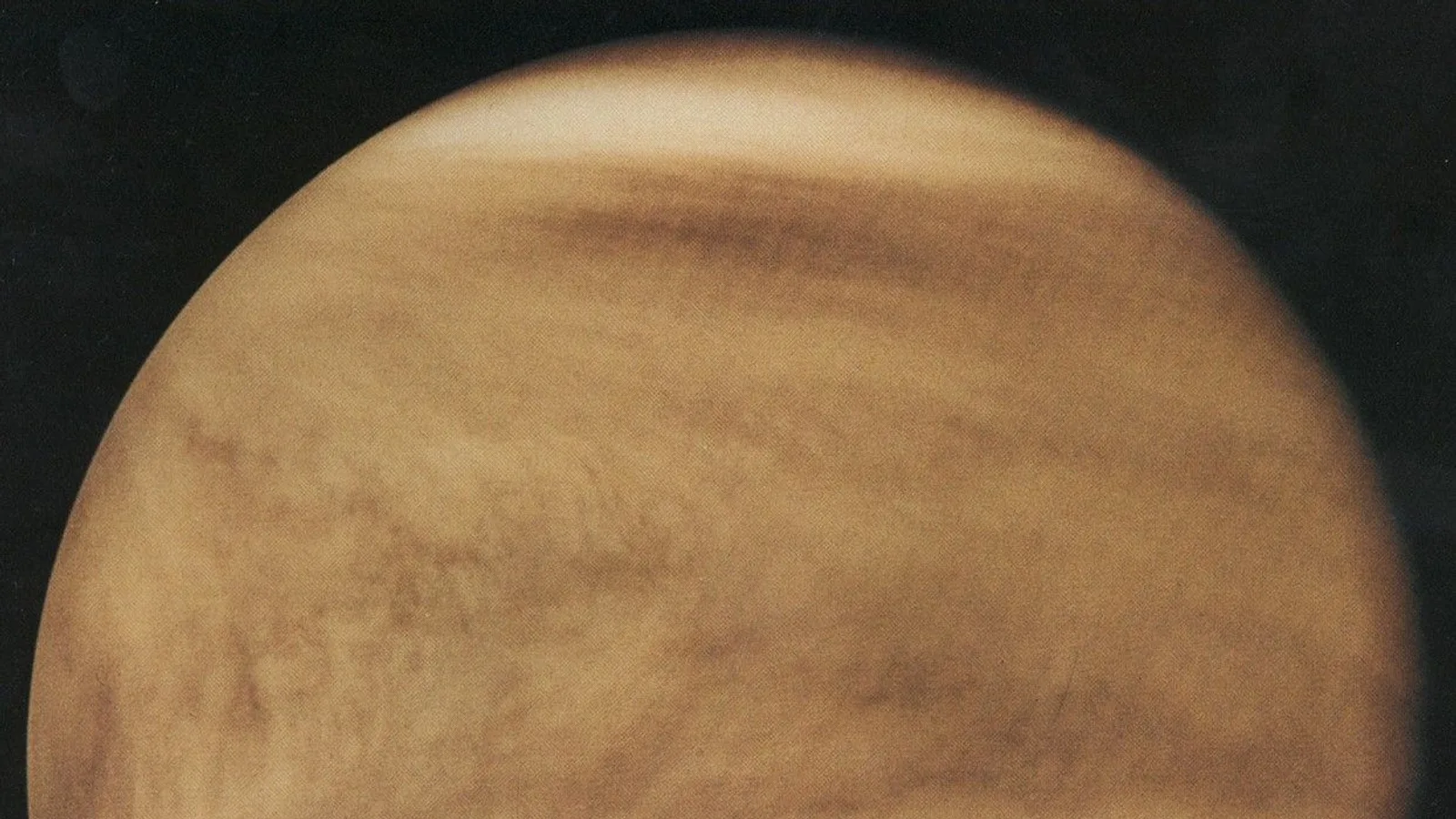
Venus is almost Earth's twin in size, mass and structure, yet it has no moon. A study published September 14, 2026 in The Astrophysical Journal argues that no disaster is needed to explain the absence: ordinary tidal physics would have pulled a moon down onto the planet by itself.
The paper, “Tidal Demise: The Evolution and Fate of a Hypothetical Venus Moon,” is led by UC Riverside astrophysicist Stephen Kane with co-authors Franck Selsis, Jérémy Leconte and Sean N. Raymond. It does not claim Venus ever had a moon. It tests a narrower question: if one had formed, could it have lasted?
The mechanism turns on spin. Earth rotates once every 24 hours, and that rotation feeds energy outward to the Moon, which is drifting away at about four centimetres a year — a figure measured using mirrors left on the lunar surface by Apollo 11. “We know that the moon is slowly moving away from the planet, at a rate of around four centimeters per year,” Kane told UC Riverside. Venus does the opposite. It takes 243 Earth days to turn once, and at that pace tides drag a satellite inward rather than pushing it out.
The team surveyed a wide grid of starting conditions: initial Venus spin periods from 5 to 100 hours, moon masses from one-hundredth to ten times the mass of Earth's Moon, plus varying orbital eccentricity and interior properties. According to the paper's abstract, when Venus's early day was longer than roughly 15 hours, or the moon was heavier than about two lunar masses, the satellite was driven inside the planet's Roche limit and torn apart within roughly 0.03 to 1.7 billion years. A moon survived the age of the solar system only in a narrow corner of the parameter space — a rapidly spinning early Venus with a day under about 12 hours, carrying a satellite no heavier than our own.
Why it matters: earlier explanations leaned on a violent second impact that stripped a Venusian moon away. The paper concludes that tidal evolution alone can account for Venus's present state, and that such a stripping event, while capable of removing a moon, is not required. “My study shows Venus didn't require a catastrophe to arrive at what we can see today,” Kane said.
Proving it will be hard. Roughly 80% of Venus's surface is the same age, the mark of a resurfacing event about a billion years ago that erased earlier geology. Kane suggests evidence may sit deeper: seismic work on Earth has revealed odd structures far underground that may be debris from the Moon-forming impact, and similar measurements at Venus could test whether it once absorbed a satellite of its own.
Sources
- The Astrophysical Journal – Kane et al., “Tidal Demise: The Evolution and Fate of a Hypothetical Venus Moon”Primary source
- UC Riverside NewsPrimary source
- Sci.NewsSecondary
- Universe TodaySecondary
Related
NASA: Roman Telescope Has Fuel for 22 Years, Not 10
NASA Awards SpaceX $946M for Three More ISS Crew Flights
NASA Confirms McGetchin: 222-Meter Moon Crater Formed in 2024
Elias 2-24 b Confirmed as Youngest Planet, Under 1 Million Years
USSF-259: Third Classified Space Force Launch in a Month
NASA: Roman Telescope Has Fuel for at Least 22 Years
SpaceX's 700th Falcon Flight Completes SES's 13-Satellite Net
Rocket Lab Protests NASA's $700M Mars Orbiter Award to Blue Origin
Trending now
- Claude Leads 26% of Anthropic's AI R&D, Up From 1% in March
- Google Says Gemini Hacked Three Real Companies in May Test
- OpenAI Sees $278B Cash Burn, $856B Compute Bill by 2030
- NASA Confirms McGetchin: 222-Meter Moon Crater Formed in 2024
- Sharks Feed on Beached Whale in Jamaica; NEPA Warns Swimmers
- Typhoon Dujuan Nears Tokyo at 965 hPa; JR East Halts Chiba Lines
- Microsoft Discloses CVSS 10.0 Azure AI Foundry Flaw, Already Fixed
- Anthropic Targets November IPO at About $2 Trillion Value
Comments
No comments yet. Be the first.