Manhattan-Size Iceberg Survives Greenland Crash
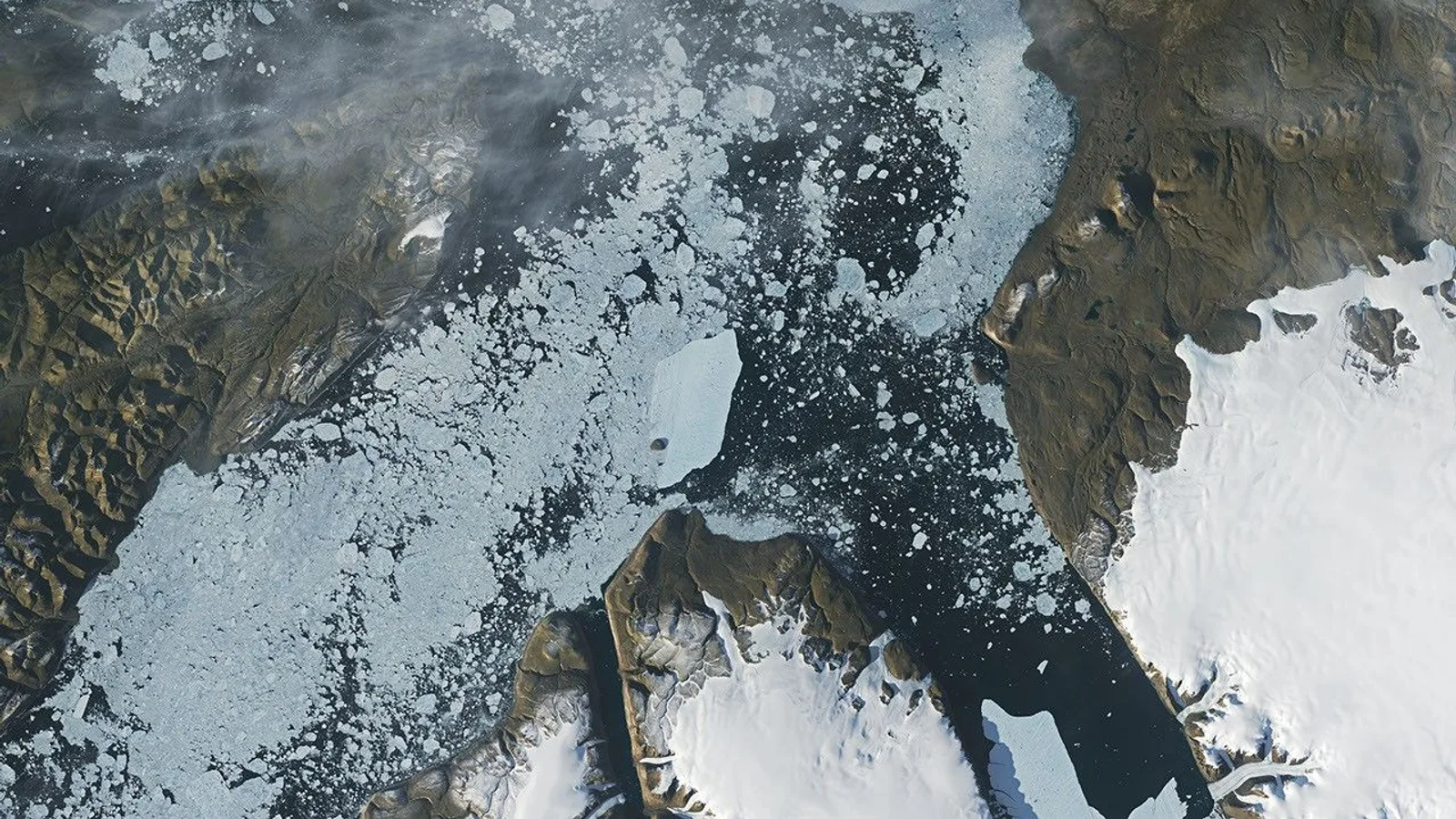
A tabular iceberg roughly the size of Manhattan has survived a head-on collision with a rocky outcrop in the Arctic, weeks after breaking away from Greenland's Petermann Glacier in one of the biggest polar calving events in years.
The 76-square-kilometer (29-square-mile) ice island split from Petermann's floating ice tongue on August 4, 2026, the glacier's largest loss of ice since a 130-square-kilometer break in 2012. Satellite imagery from the European Space Agency's Sentinel-1 mission was first analyzed by Adam Garbo, a doctoral student in glaciology at the University of Ottawa, who tracked the event. NASA counts it as the Arctic's largest single calving event since 2020.
Drifting down Petermann Fjord at roughly 3 kilometers a day, the berg reached the narrow mouth where the fjord meets Nares Strait and rammed into Joe Island, a small rocky outcrop that has fractured earlier icebergs at the same spot. Landsat 9 satellite images from August 23-24 show the ice island absorbing the impact intact. "We were certainly watching closely as it interacted with Joe Island and were impressed that it survived the interaction without further fragmentation," Garbo said in an account NASA's Earth Observatory published on September 4.
Why now: the September 4 NASA update is the first confirmation that the berg cleared its riskiest obstacle without breaking apart, a detail scientists had been watching for since the collision took place two weeks earlier. Wind and currents have since pushed it out of the fjord, and it is now pivoting southwest through Nares Strait, where glaciologist Mauri Pelto of Nichols College is tracking its path using Landsat imagery.
Why it matters: Petermann is one of Greenland's largest marine-terminating glaciers, and its floating ice shelf helps hold back the flow of land ice into the ocean. Scientists watch its stability closely because faster ice loss there could add to global sea-level rise. Petermann's ice tongue has been thinning for years as warmer ocean water erodes it from below, and researchers use calving events like this one to gauge how quickly the glacier's grounding line, the point where the ice lifts off bedrock, might retreat.
NASA says two more ice islands, one around 94 square kilometers and another around 84 square kilometers, are expected to break off from existing rifts in the glacier's remaining ice tongue in the coming months.
Related
Dinosaur Dung Preserves First Known Feathers of a Diving Bird
2,884 Supernovae Favour Changing Dark Energy at 3.3 Sigma
Chandra Archive Yields 84 'Hypersoft' X-Ray Sources in 6 Galaxies
Landsat 8 Image Confirms Mount Michael's Persistent Lava Lake
World's Biggest Dark Matter Detector Spots Mystery Particle
New Simulations: Moon May Have Formed in Just 5 Hours
Dark matter hunt sees one puzzling particle — not proof yet
Fusion Reactor 'Flaw' Found to Suppress Turbulence
Trending now
- King Charles Convenes AI Leaders in Scotland, Palace Confirms
- Celine Dion Opens 16-Show Paris Run, First Concert in 6 Years
- Fake IT Helpdesk Calls Defeat Passkey Logins, Microsoft Says
- Zverev Beats Shelton in 4 Sets for First US Open Title
- VW Mission Efficiency Sets 0.158 Cd World Record
- Marvel's Wolverine Lands on PS5 With a 77 Metascore
- Revolut Breach: Attackers Demanded 10,000 Bitcoin Ransom
- Saudi Pipeline Repairs to Take Weeks as Brent Tops $107
Comments
No comments yet. Be the first.