World's Biggest Dark Matter Detector Spots Mystery Particle
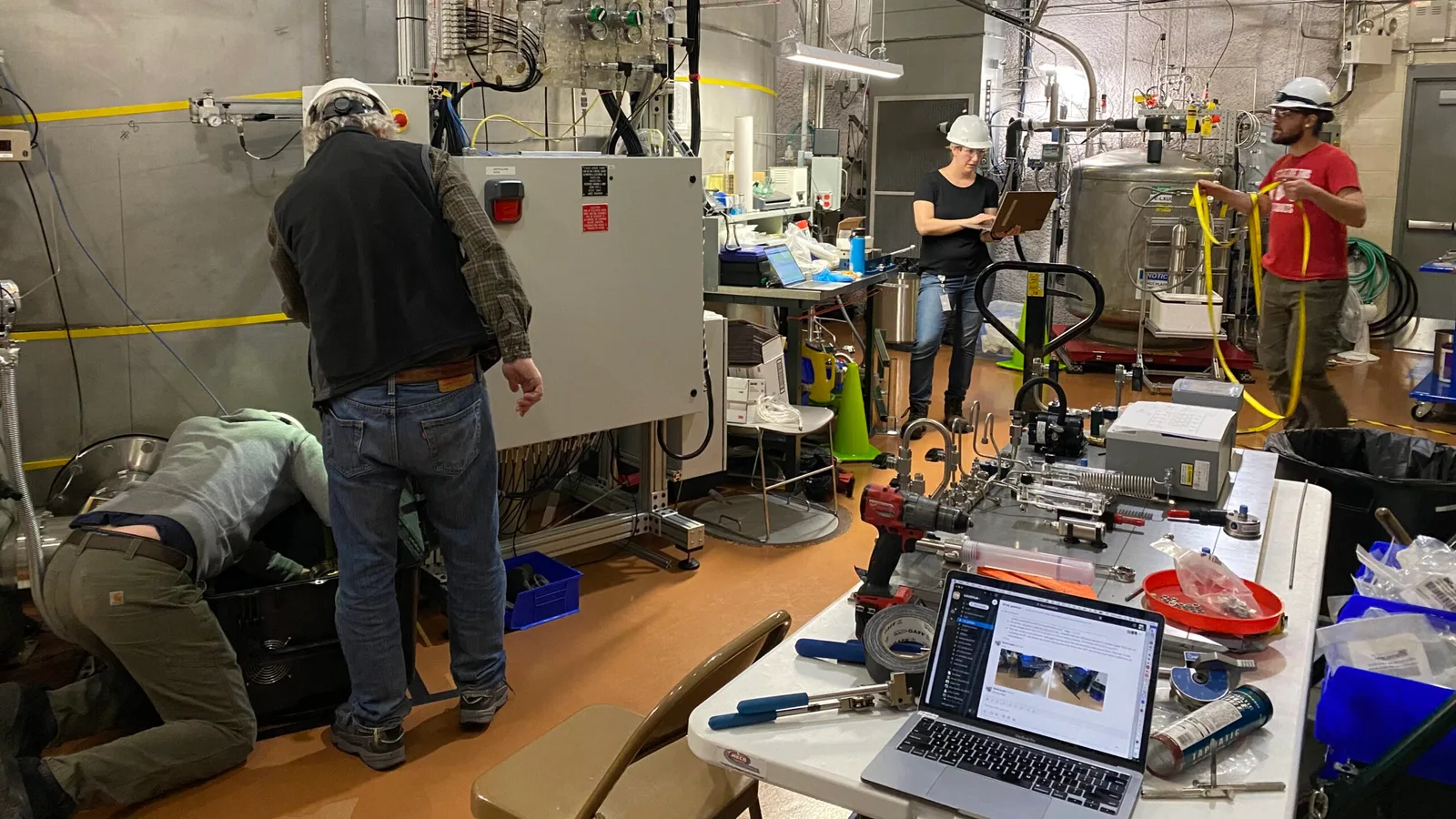
Scientists working on the world's most sensitive dark matter experiment say they have detected a single, unexplained particle interaction that could be an early hint of dark matter — though they are urging caution before drawing conclusions.
The LUX-ZEPLIN (LZ) detector, buried nearly a mile underground at the Sanford Underground Research Facility in South Dakota, uses 10 tonnes of ultra-pure liquid xenon to search for weakly interacting massive particles, or WIMPs, one of the leading theoretical candidates for dark matter. The unusual event, drawn from 220 days of data collected between March 2023 and April 2024, is consistent with a WIMP of at least 200 gigaelectronvolts — more than 200 times the mass of a proton.
The finding registers at a statistical significance of 2.6 sigma, meaning there is roughly a 0.5% chance the signal comes from ordinary background sources. That is far short of the 5-sigma threshold physicists require before claiming a genuine discovery, and researchers stressed the result should be treated as intriguing rather than conclusive.
"We are not claiming to have seen dark matter," said Rick Gaitskell of the LZ collaboration, calling the event "interesting" but preliminary. UCLA physicist Alvine Kamaha said the result "could represent the first hint of a dark-matter signal, though we can't say that for certain yet," while colleague Aaron Manalaysay described it as the first outlier he has seen in any experiment that "appears valid in every way."
The result was presented at the TeV Particle Astrophysics conference in Japan and has been submitted to Physical Review Letters. The LZ collaboration says it will continue collecting data to determine whether the signal strengthens, weakens, or disappears as more results come in.
Related
Dinosaur Dung Preserves First Known Feathers of a Diving Bird
2,884 Supernovae Favour Changing Dark Energy at 3.3 Sigma
Chandra Archive Yields 84 'Hypersoft' X-Ray Sources in 6 Galaxies
Landsat 8 Image Confirms Mount Michael's Persistent Lava Lake
Manhattan-Size Iceberg Survives Greenland Crash
New Simulations: Moon May Have Formed in Just 5 Hours
Dark matter hunt sees one puzzling particle — not proof yet
Fusion Reactor 'Flaw' Found to Suppress Turbulence
Trending now
- King Charles Convenes AI Leaders in Scotland, Palace Confirms
- Celine Dion Opens 16-Show Paris Run, First Concert in 6 Years
- Fake IT Helpdesk Calls Defeat Passkey Logins, Microsoft Says
- Zverev Beats Shelton in 4 Sets for First US Open Title
- VW Mission Efficiency Sets 0.158 Cd World Record
- Marvel's Wolverine Lands on PS5 With a 77 Metascore
- Revolut Breach: Attackers Demanded 10,000 Bitcoin Ransom
- Saudi Pipeline Repairs to Take Weeks as Brent Tops $107
Comments
No comments yet. Be the first.