New Simulations: Moon May Have Formed in Just 5 Hours
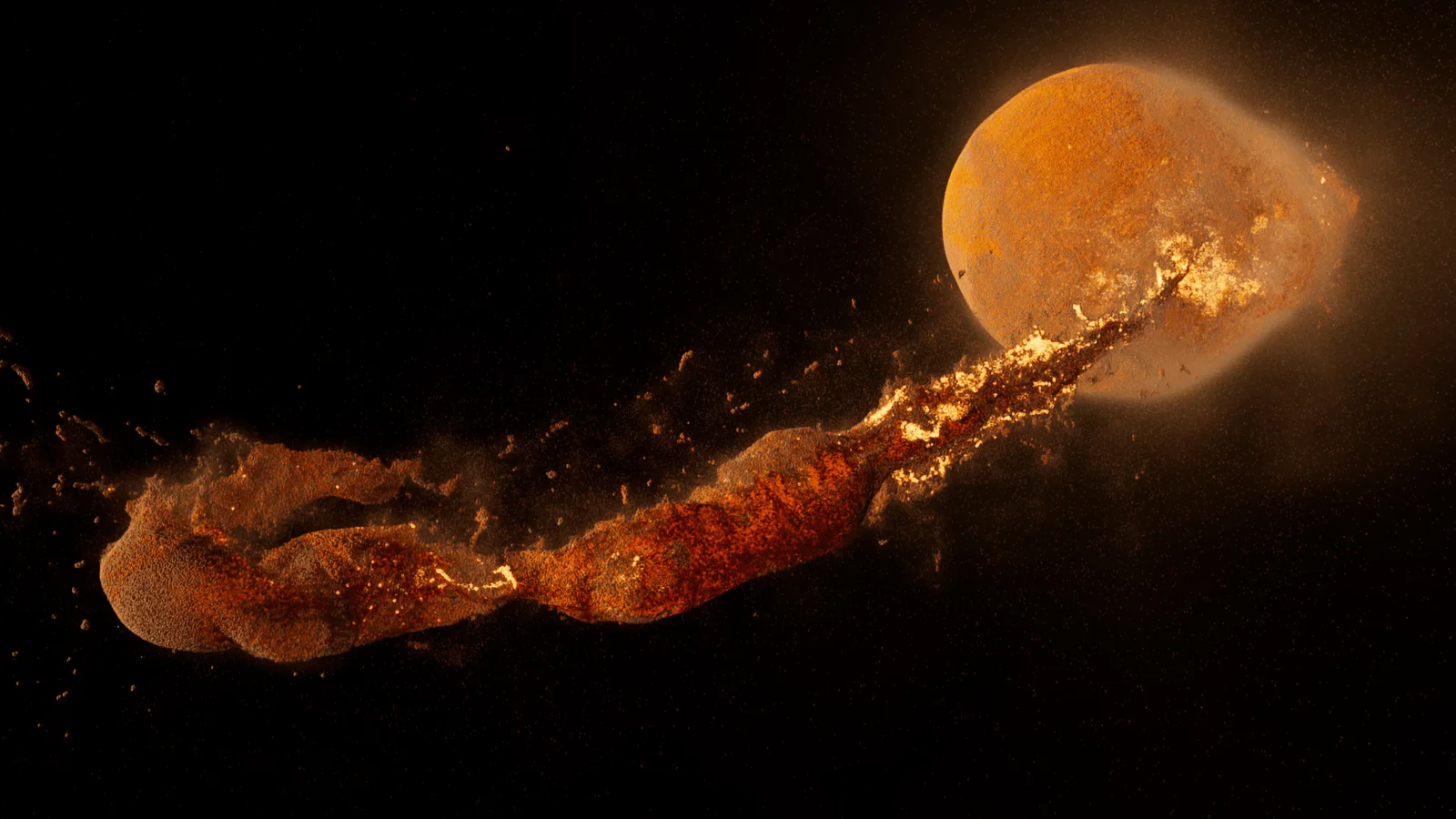
New computer simulations suggest the Moon may have snapped into existence within about five hours of a colossal collision that struck early Earth billions of years ago, according to research led by the Southwest Research Institute (SwRI) in collaboration with the University of Arizona.
The study, led by SwRI researcher Dr. Adeene Denton with University of Arizona professor Dr. Erik Asphaug, revisited the long-standing giant impact hypothesis, which holds that the Moon formed from debris left after a Mars-sized protoplanet known as Theia slammed into the young Earth roughly 4.5 billion years ago. Rather than treating the two bodies as simple fluids, the team's new models incorporated temperature-dependent material strength, essentially giving the simulated Earth and Theia realistic geologic properties.
"When you simulate the Earth and the moon as colliding bodies with geologic properties, it changes how the moon forms out of that impact," Denton said, describing the shift from earlier models that ignored how rock strength changes with heat.
The results split into two distinct outcomes depending on temperature. When proto-Earth and Theia were modeled as relatively cool and mechanically strong, the simulations produced an intact Moon in orbit within about five hours of impact. When the same bodies were modeled as hotter and weaker, consistent with freshly formed planets, the collision instead produced a disk of debris around Earth that would have taken much longer to gradually assemble into the Moon.
Because young protoplanets are thought to start out hot and cool over time, the researchers say the findings establish a new link between exactly when in Earth's early history the giant impact occurred and what kind of Moon it produced. NASA highlighted the work, noting it adds a fresh variable, thermal history, to a debate that has run for decades over how quickly and directly the Moon came together.
The research, published in The Astrophysical Journal Letters, does not resolve one of the giant impact hypothesis's biggest outstanding problems: explaining why Moon rocks are so chemically and isotopically similar to Earth's, since simulations have historically predicted the Moon should be made mostly of material from the impactor, Theia. Denton's team says the next step is testing how these fast- and slow-formation scenarios would each affect the Moon's early composition and structure, which could help future lunar sample studies pin down which scenario actually happened.
Related
Dinosaur Dung Preserves First Known Feathers of a Diving Bird
2,884 Supernovae Favour Changing Dark Energy at 3.3 Sigma
Chandra Archive Yields 84 'Hypersoft' X-Ray Sources in 6 Galaxies
Landsat 8 Image Confirms Mount Michael's Persistent Lava Lake
Manhattan-Size Iceberg Survives Greenland Crash
World's Biggest Dark Matter Detector Spots Mystery Particle
Dark matter hunt sees one puzzling particle — not proof yet
Fusion Reactor 'Flaw' Found to Suppress Turbulence
Trending now
- King Charles Convenes AI Leaders in Scotland, Palace Confirms
- Celine Dion Opens 16-Show Paris Run, First Concert in 6 Years
- Fake IT Helpdesk Calls Defeat Passkey Logins, Microsoft Says
- Zverev Beats Shelton in 4 Sets for First US Open Title
- VW Mission Efficiency Sets 0.158 Cd World Record
- Marvel's Wolverine Lands on PS5 With a 77 Metascore
- Revolut Breach: Attackers Demanded 10,000 Bitcoin Ransom
- Saudi Pipeline Repairs to Take Weeks as Brent Tops $107
Comments
No comments yet. Be the first.