2,884 Supernovae Favour Changing Dark Energy at 3.3 Sigma
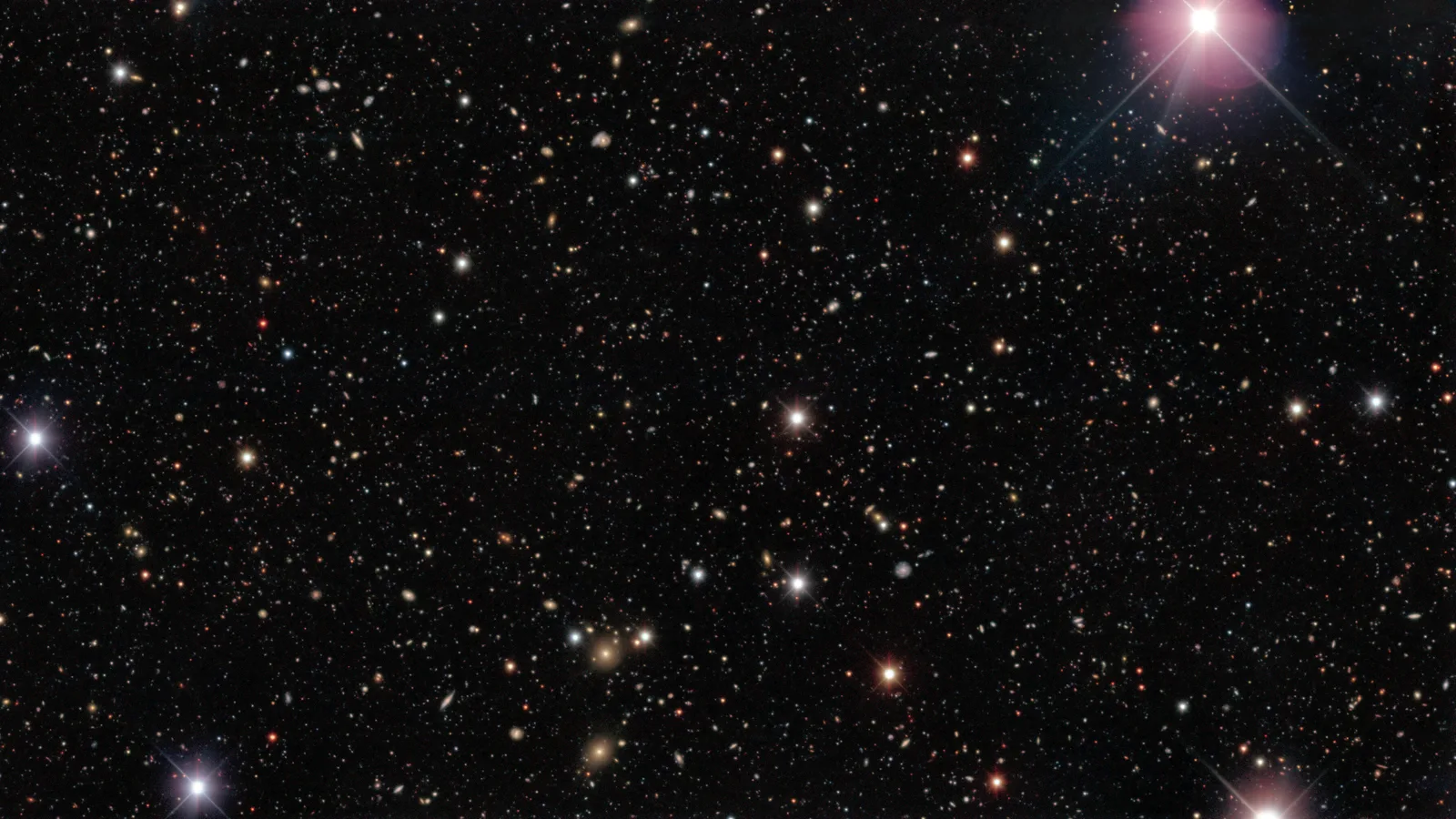
An international team led by University of Queensland PhD candidate Ryan Camilleri has merged the two largest catalogues of Type Ia supernovae into a single, uniformly analysed sample of 2,884 likely Type Ia explosions, which the authors call Unite. The paper, "Supernovae Unite: Combining Pantheon+ and DES-SN5YR", was posted to the arXiv preprint server on 4 September 2026 and revised on 9 September 2026; the University of Queensland announced the results on 8 September 2026. According to the paper, the combined data fit a universe in which dark energy weakens over time better than one in which it stays fixed.
What is new is the merger itself. Pantheon+ and the Dark Energy Survey's five-year sample (DES-SN5YR) were built separately, with different calibrations and assumptions, which limited how forcefully the two could be compared. Camilleri's team re-analysed both with the same supernova modelling, the same sample selection and the same bias corrections, and redetermined host-galaxy stellar masses for more than 98% of the sample. "We've rebuilt three decades of astronomical observations into a single, consistent framework," Camilleri said in the UQ release, adding that the team had learned more about how supernovae behave and could "go back and apply that improved understanding to older data." From Unite alone, the authors measure a matter density of 0.310 (+0.012/-0.011) for a flat universe with a cosmological constant.
The tension appears when the supernovae are combined with cosmic microwave background data and baryon acoustic oscillation measurements from DES and DESI. Holding dark energy's equation of state constant, the authors report strong evidence of tension between the CMB and the combined BAO and supernova data. Letting that equation of state vary with time relieves it, giving a matter density of 0.305, a present-day equation of state of -0.861 and a rate of change of -0.60, and shrinking the confidence region by about 30% against the earlier DES Y6, DESI-DR2 and CMB combination. Co-author Tamara Davis said in the UQ release that DES supernova data in 2024 first hinted at time-varying dark energy and that the new compilation also deviates from the standard model, "although in a slightly different direction". "So, two completely independent measurements have found hints of time variation in dark energy, challenging the standard model that dark energy doesn't change," she said.
What the paper does not claim is proof. Frequentist analyses prefer evolving dark energy over the flat cosmological-constant model at 3.3 sigma using the maximum a posteriori probability, or 3.1 sigma using maximum likelihood, short of the 5 sigma physicists treat as a discovery. The authors also state that the Bayesian evidence indicates only a weak preference for time-evolving dark energy, so the two statistical approaches disagree on how strong the hint really is. The arXiv posting is a preprint that lists Publications of the Astronomical Society of Australia as its target journal and has not been through peer review.
Sources
- arXiv: Supernovae Unite: Combining Pantheon+ and DES-SN5YR (Camilleri et al.)Primary source
- University of Queensland: Big supernova dataset challenges dark energy theoryPrimary source
- Phys.org: Big supernova dataset challenges dark energy theorySecondary
- Sci.News: Dark Energy May Not Be Constant After All, New Supernova Survey SuggestsSecondary
Related
Dinosaur Dung Preserves First Known Feathers of a Diving Bird
Chandra Archive Yields 84 'Hypersoft' X-Ray Sources in 6 Galaxies
Landsat 8 Image Confirms Mount Michael's Persistent Lava Lake
Manhattan-Size Iceberg Survives Greenland Crash
World's Biggest Dark Matter Detector Spots Mystery Particle
New Simulations: Moon May Have Formed in Just 5 Hours
Dark matter hunt sees one puzzling particle — not proof yet
Fusion Reactor 'Flaw' Found to Suppress Turbulence
Trending now
- Fake IT Helpdesk Calls Defeat Passkey Logins, Microsoft Says
- Zverev Beats Shelton in 4 Sets for First US Open Title
- VW Mission Efficiency Sets 0.158 Cd World Record
- Marvel's Wolverine Lands on PS5 With a 77 Metascore
- Revolut Breach: Attackers Demanded 10,000 Bitcoin Ransom
- Saudi Pipeline Repairs to Take Weeks as Brent Tops $107
- Treasury Yield Tops 5.014%, Highest Since 2023, Then Retreats
- US Diesel Sets Record $6.23 a Gallon, AAA Figures Show
Comments
No comments yet. Be the first.