Anthropic hires Google TPU pioneer as Claude maker builds its own AI chips
# Anthropic hires Google TPU pioneer as Claude maker builds its own AI chips
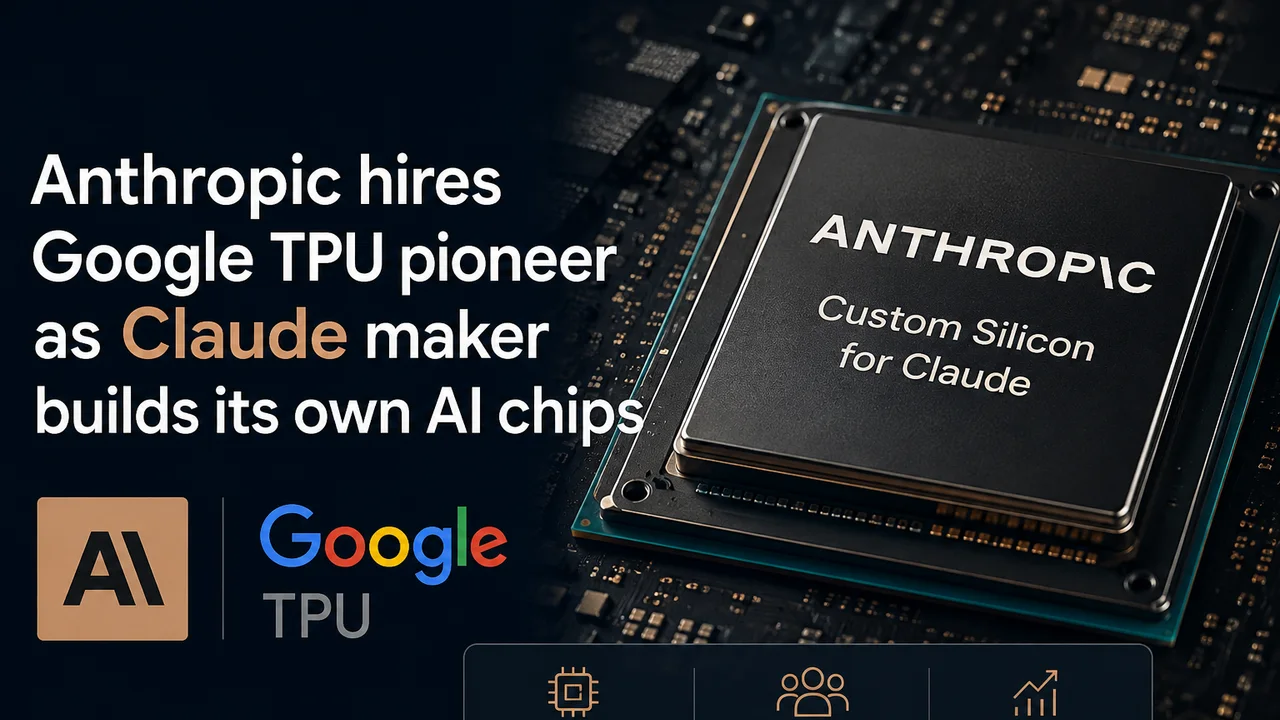
Anthropic is accelerating its push into custom AI hardware, hiring one of the key figures behind Google's Tensor Processing Unit program as the Claude maker begins building its own semiconductor capabilities.
Amir Salek, a former Google executive who helped lead the company's custom silicon efforts, is joining Anthropic's compute team, Bloomberg reported.
The move is significant because Anthropic has already confirmed that it is assembling an internal team to design custom chips optimized for Claude.
Together, the developments suggest that one of the world's largest AI companies wants greater control over the hardware underneath its models.
## Anthropic hires a Google TPU veteran
Salek spent nearly a decade at Google and helped lead its custom chip program.
During his time there, he was involved in delivering the first seven generations of Google's Tensor Processing Units, or TPUs, according to Bloomberg.
TPUs are specialized processors designed specifically for machine-learning workloads.
Unlike general-purpose processors, AI accelerators can be optimized around the enormous matrix calculations required to train and run neural networks.
Google's decision to develop TPUs gave the company an alternative to relying exclusively on GPUs from companies such as Nvidia.
Anthropic is now beginning a similar journey.
Salek will join Anthropic's compute organization and report to James Bradbury, according to Bloomberg.
Before Google, Salek also spent years at Nvidia, giving him experience at two of the most important companies in modern AI hardware.
## Anthropic has already confirmed its custom chip plans
The hiring follows a major announcement from Anthropic earlier this month.
On August 5, the company confirmed that it was creating an internal custom silicon team to design chips for its Claude AI models.
Anthropic said it wants engineers across both the hardware and software stack to work together on processors specifically optimized for its models.
The goal is to make Claude faster and more efficient while supporting the enormous scale required by increasingly popular AI services.
Anthropic's current careers page also shows the company recruiting for hardware-related positions, including a Research Engineer role focused on chip-design reinforcement learning and TPU kernel engineering.
That makes the Salek hire particularly notable.
Anthropic is no longer simply exploring the idea of designing chips.
It is recruiting people with experience building some of the world's most successful AI accelerators.
## Why does Claude need its own chip?
Running frontier AI models requires enormous amounts of computing power.
Companies developing systems such as Claude have traditionally relied heavily on processors designed by other companies.
Anthropic currently uses a diversified infrastructure strategy that includes technology from Amazon Web Services, Google, Nvidia and AMD.
The company says it plans to continue using those platforms even as it develops its own silicon.
But custom hardware offers several potential advantages.
Instead of designing software around whatever hardware is available, Anthropic could eventually design Claude and its processors together.
That could improve performance, reduce power consumption and potentially lower the cost of generating AI responses.
It could also reduce exposure to shortages of the most advanced AI accelerators.
Anthropic cited limited chip availability as one of the motivations behind its decision to build a custom silicon team.
## Nvidia isn't disappearing from Anthropic's data centers
Developing a custom AI accelerator does not mean Anthropic is abandoning Nvidia or its other hardware partners.
Anthropic has explicitly described the initiative as part of a multi-chip strategy.
The company expects Nvidia GPUs, Google's TPUs, Amazon's Trainium processors and AMD hardware to continue playing important roles in its infrastructure.
Building a state-of-the-art processor is also extremely expensive.
Reuters reported that developing an advanced AI chip can cost roughly $500 million once engineering, verification and manufacturing preparation are included.
Anthropic has not announced when its first internally designed processor might appear or which semiconductor manufacturer would produce it.
That means any Anthropic-designed Claude accelerator is likely still some distance away.
## AI companies want more control over their hardware
Anthropic's move reflects a much broader shift across the artificial intelligence industry.
The largest AI companies increasingly see chips as a strategic part of their businesses rather than a component they simply purchase.
Google has developed TPUs for years.
Amazon has Trainium and Inferentia.
Meta has developed its MTIA accelerator.
OpenAI has also been pursuing custom silicon.
Now Anthropic is building its own team.
The reason is straightforward: AI models are becoming so expensive to train and operate that even small improvements in hardware efficiency can produce enormous savings when multiplied across massive data centers.
Greater control over chip design can also allow AI developers to optimize processors around the exact workloads generated by their models.
## Anthropic's compute ambitions are getting bigger
The company is simultaneously securing enormous quantities of computing infrastructure.
In June, Apollo and Blackstone backed a roughly $35 billion expansion of computing capacity tied to Anthropic and Broadcom, according to Reuters.
The first phase involves approximately one gigawatt of computing capacity, with longer-term plans connected to substantially larger deployments.
That helps show the scale of the problem Anthropic is trying to solve.
Claude is no longer simply a piece of software running on a handful of GPUs.
Supporting frontier AI models increasingly requires data centers, specialized networking, power infrastructure and hundreds of thousands of advanced processors.
By hiring one of the architects of Google's TPU effort, Anthropic is signaling that it wants to participate much deeper in that technology stack.
The competition between AI companies is no longer only about who has the best model.
Increasingly, it is also about who controls the chips underneath it.
Related
Claude Finds CRISPR-Like Enzyme System in 21-Hour DNA Search
Anthropic Cuts Opus Costs 40%, OpenAI Answers in an Hour
StepFun's 600B Step 5 Scores 44 at $1 per Million Tokens
Claude Leads 26% of Anthropic's AI R&D, Up From 1% in March
Universal, Sony Sue Suno Again Over 60,202 Recordings
Alibaba Open-Sources CT AI That Flags 146 Conditions
Claude Sped Up 30+ Biology Models 4x, $1M Protein Contest Opens
King Charles to AI Leaders: Control 'Before It Is All Too Late'
Trending now
- US-China Trade Truce Extended to Jan. 10 as Xi Visits
- Amoeba Breeds at 63°C, Past the 60°C Limit for Complex Life
- 996 Zyxel Switches Looted in 48 Countries; Patch Due Sept. 24
- Oracle Invokes Force Majeure on 2.45GW Stargate Data Center
- Diller Drops $18B MGM Bid; Stock Falls 9.5% to February Levels
- Taylor Swift Adds 4 Songs to ‘Showgirl’ in Sept. 25 Encore
- Attacks on WordPress RCE Flaw Rose Tenfold After Sept. 22 Fix
- Rivian Recalls 98,828 EVs Over Rearview Camera Fault
Comments
No comments yet. Be the first.