Claude Sped Up 30+ Biology Models 4x, $1M Protein Contest Opens
Anthropic published research on 17 September 2026 describing how an internal, general-purpose Claude research model rewrote the software that structural biologists run every day. In just under four weeks, the company says, Claude produced optimized packages for 36 implementations covering more than 30 open-source biomolecular deep learning models, spanning structure prediction, protein design, genomics and protein language models.
The numbers come from Anthropic's own technical report. A "Fast" mode, trading a little numerical precision for speed, ran the forward pass of 13 structure prediction models an average of 4.1x faster on NVIDIA H100 GPUs. An "Exact" mode, which reproduces the unmodified model's outputs bit for bit, averaged 1.6x across 14 models. Per-model gains ranged from 2.3x for OpenDDE to 6.4x for Chai-1. The optimized code went out the same day on GitHub as 36 drop-in kits under the Apache 2.0 licence, flagged as an unmaintained reference release.
At the centre of the work is FlashPairformer, a set of custom GPU kernels for triangle attention and triangle multiplication - the operations that dominate runtime in AlphaFold3-class models and whose cost grows cubically with system size. Anthropic reports FlashPairformer beating the field-standard kernels by 2.7x and 2.9x on triangle attention and by 1.7x and 3.2x on triangle multiplication, measured on a single H100. Anthropic says two members of its technical staff supervised the work: both knew biomolecular modelling, neither had prior experience in inference optimization or kernel engineering.
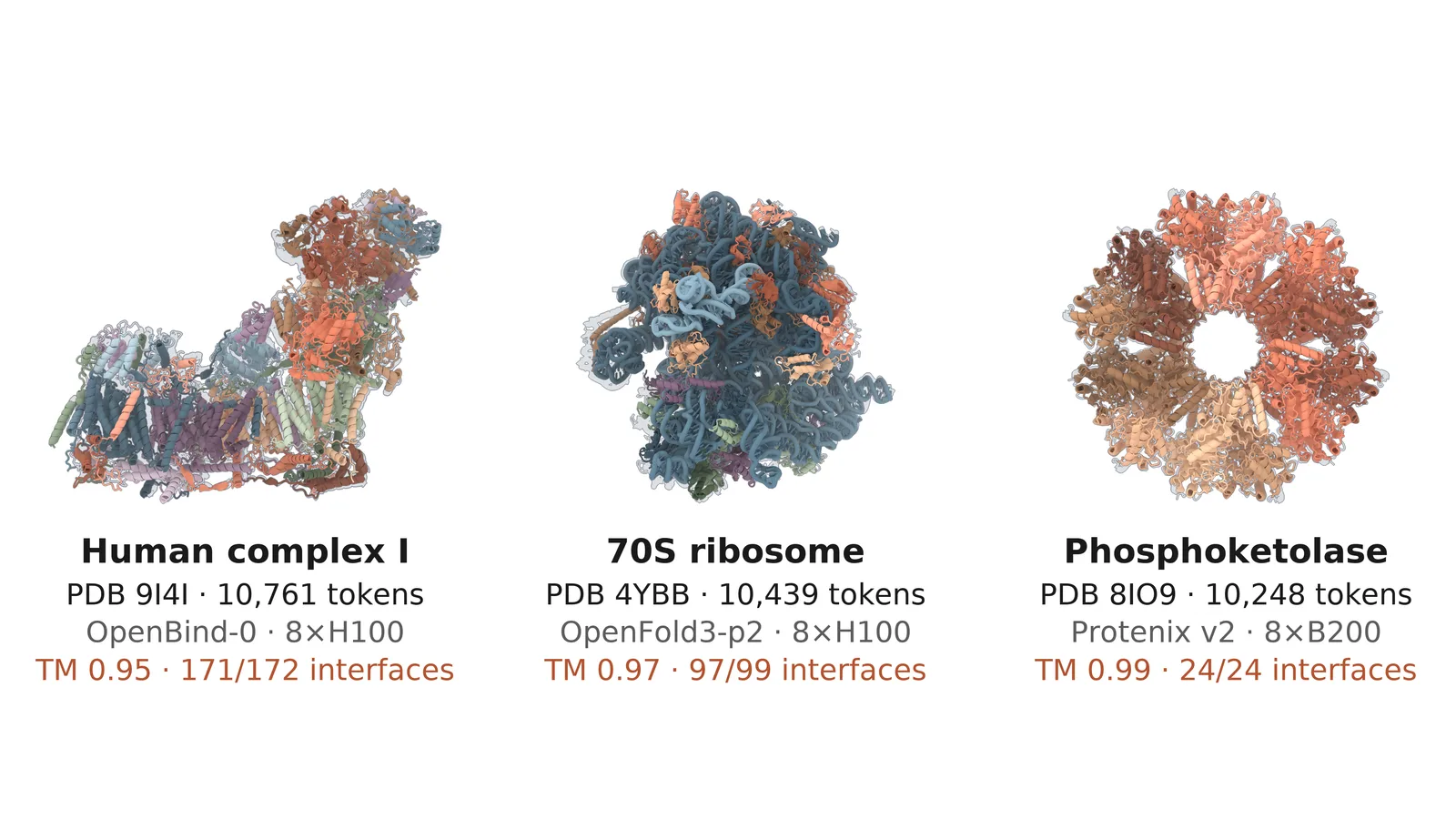
The practical payoff is a low-memory "Big" mode that lets a single NVIDIA GPU node fold systems larger than 10,000 tokens - human mitochondrial complex I, a bacterial 70S ribosome, the TRiC chaperone and a proteasome, each closely matching its experimentally determined structure. For scale, the 40S ribosome AlphaFold3 predicted accurately was 7,663 tokens. Anthropic also reports matching the in-silico binding scores of its earlier binder-design campaign using one Claude model on a single H200 for 24 hours and roughly $150 in combined GPU and token spend, against up to $10,000 per target before.
The post states its own limits: pushed to viral capsids and protein compartments of 31,000 to 70,000 tokens on one 8-GPU B300 node, the predictions collapse. And in-silico scores are not laboratory evidence - which is what the competition co-sponsored with Adaptyv Bio is meant to supply. The two are jointly funding $1 million in experimental validation to synthesize and test more than 5,000 community-submitted designs in Adaptyv's automated lab at no cost to participants, with Anthropic adding up to $1 million in Claude credits, Modal up to $250,000 in compute credits and Twist Bioscience the DNA. There is no cash prize. Five challenges - among them species cross-reactivity, pH sensitivity, peptide-MHC specificity and GPCR targets - open one a week from 28 September to 31 October; applications close on 24 September, validation is due by 30 November, and results including failed designs are to be published openly on Proteinbase on 15 December. The schedule is described as planned and subject to change.
Disclosure: NewUJ's editorial process uses Anthropic's Claude models.
Sources
- Anthropic ResearchPrimary source
- Anthropic teknik rapor (PDF)Primary source
- Proteinbase - Anthropic x Adaptyv Protein Design CompetitionPrimary source
- GitHub - anthropics/uplifting-biomolecular-modelingPrimary source
- Unite.AISecondary
Related
Claude Leads 26% of Anthropic's AI R&D, Up From 1% in March
Universal, Sony Sue Suno Again Over 60,202 Recordings
Alibaba Open-Sources CT AI That Flags 146 Conditions
King Charles to AI Leaders: Control 'Before It Is All Too Late'
Google Home Opens to Claude and Other AI Agents, Not Just Gemini
Huawei's 4,096-Chip AI System Replaces 48,000 Optical Modules
Anthropic Merges Cowork Into Claude, Adds Docs and Slides
OpenAI Reports 6 Cases of Models Hiding Errors, Faking Data
Trending now
- Claude Leads 26% of Anthropic's AI R&D, Up From 1% in March
- Google Says Gemini Hacked Three Real Companies in May Test
- OpenAI Sees $278B Cash Burn, $856B Compute Bill by 2030
- Sharks Feed on Beached Whale in Jamaica; NEPA Warns Swimmers
- Microsoft Discloses CVSS 10.0 Azure AI Foundry Flaw, Already Fixed
- Anthropic Targets November IPO at About $2 Trillion Value
- Universal, Sony Sue Suno Again Over 60,202 Recordings
- China's CXMT Starts Mass Production of 11.95nm G5 DRAM
Comments
No comments yet. Be the first.