Huawei's 4,096-Chip AI System Replaces 48,000 Optical Modules
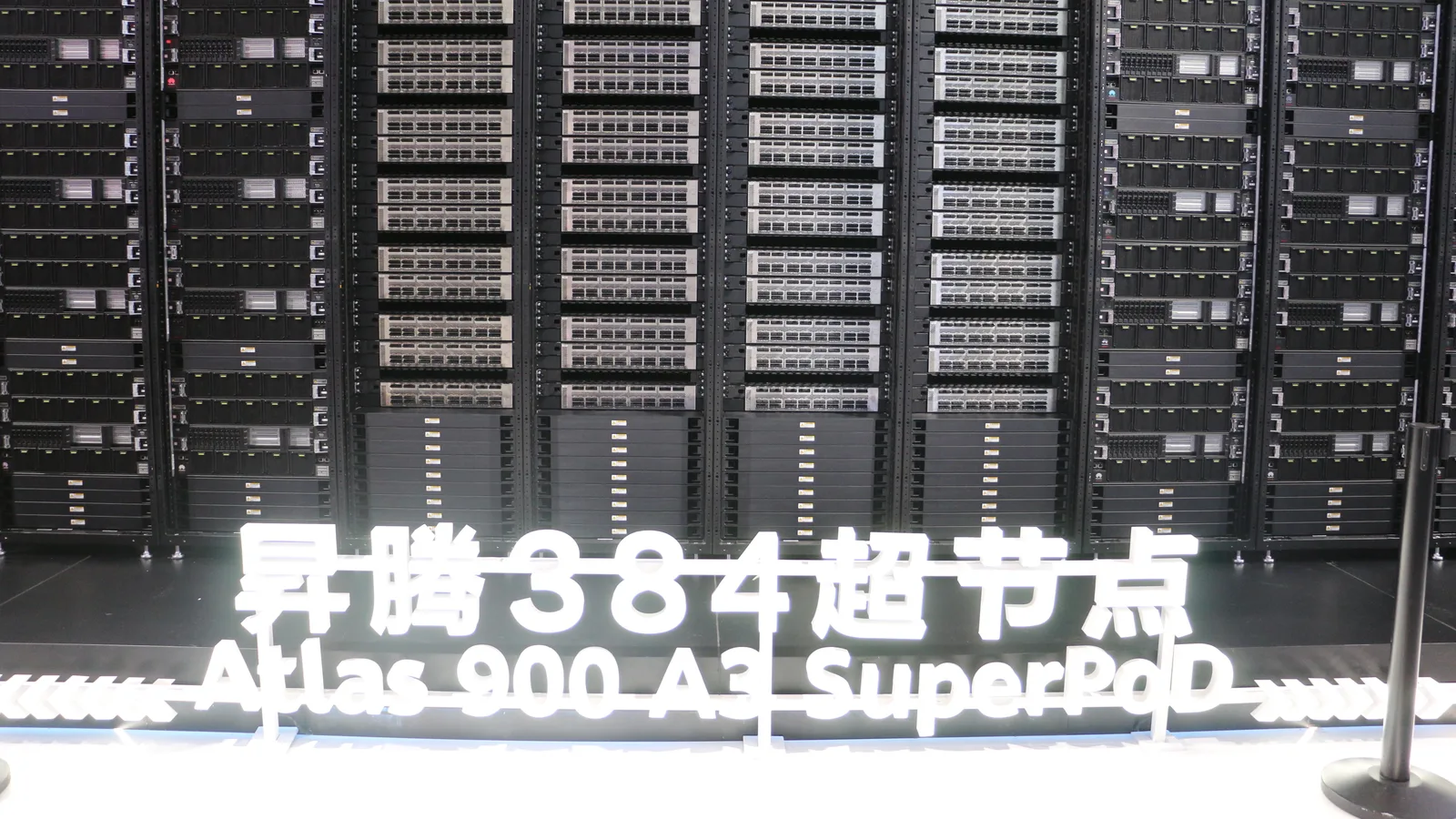
Huawei opened its annual Huawei Connect conference in Shanghai on 17 September 2026 with the launch of a new flagship AI computing system. Deputy Chairman and Rotating Chairman Wang Tao, who also uses the name David Wang, presented the Atlas 960E SuperPoD in the opening keynote. Huawei describes it as the industry's first AI computing system built on near-packaged optics, or NPO. The system ties together 4,096 accelerator cards; Huawei rates it at up to 8 EFLOPS of FP8 compute and 1 petabyte of HBM memory.
The optics are the part worth slowing down for. According to Huawei's own account of the keynote, a single Atlas 960E SuperPoD uses roughly 5,500 of its new Hi-ONE optical engines in place of the roughly 48,000 800G pluggable optical modules a conventional design of the same scale would need. Huawei says the substitution cuts more than 550 kilowatts of power draw, doubles mean time between failures and lifts system availability to 99.8%. Each Hi-ONE engine is rated at 7.2 terabits per second, and Huawei calls it the first NPO product in mass production with an integrated light source. These are company figures; none of them have been independently benchmarked.
The timing is deliberate. Huawei also pulled its chip roadmap forward, with the Ascend 960DT now due in the first quarter of 2027, three quarters ahead of the original plan, and the 960PR in the third quarter, according to the Reuters dispatch from Shanghai. The Ascend 970 and 980 are scheduled for 2028 and 2029. The announcement landed days before an expected meeting between U.S. President Donald Trump and Chinese President Xi Jinping in Washington on 24 September. George Chen, a partner at The Asia Group consultancy, told the Associated Press the timing "underscores Beijing's confidence and ambition in technology and innovation." The AP framed the week as a narrowing, not a closing, of the gap with Nvidia.
The most consequential line came from a different executive. Rotating chairman Eric Xu told reporters that Huawei cannot build enough AI computing equipment for China alone. "Since we don't have enough capacity to even satisfy the demand in China, we don't have a plan to expand into the international market in a fully-fledged way," Xu said, per Reuters. Huawei supplies a handful of countries where demand is unusually strong, he added, but volumes stay limited.
Two questions stay open. Huawei's own September 2025 announcement listed an Atlas 960 SuperPoD with 15,488 Ascend NPUs on its roadmap; the machine launched this week carries an "E" suffix and the 4,096-card configuration, and Huawei's Chinese-language materials call it the Ascend 960 SuperPoD, while the AP simply used the name Atlas 960 SuperPoD. Huawei's written release gave no availability date for the SuperPoD. Accounts from the keynote point to an air-cooled version in the second quarter of 2027 and a liquid-cooled one in the third, unconfirmed in writing.
Disclosure: NewUJ's editorial process uses Anthropic's Claude models.
Sources
- Huawei — Huawei Unveils World's Most Powerful SuperPoDs and SuperClusters (18 Sept 2025)Primary source
- Associated Press (via News4JAX)Agency
- Reuters (via GuruTrade)Agency
- Inside AISecondary
- Saudi ShopperSecondary
- Huawei CentralSecondary
Related
Claude Leads 26% of Anthropic's AI R&D, Up From 1% in March
Universal, Sony Sue Suno Again Over 60,202 Recordings
Alibaba Open-Sources CT AI That Flags 146 Conditions
Claude Sped Up 30+ Biology Models 4x, $1M Protein Contest Opens
King Charles to AI Leaders: Control 'Before It Is All Too Late'
Google Home Opens to Claude and Other AI Agents, Not Just Gemini
Anthropic Merges Cowork Into Claude, Adds Docs and Slides
OpenAI Reports 6 Cases of Models Hiding Errors, Faking Data
Trending now
- Claude Leads 26% of Anthropic's AI R&D, Up From 1% in March
- Google Says Gemini Hacked Three Real Companies in May Test
- OpenAI Sees $278B Cash Burn, $856B Compute Bill by 2030
- Sharks Feed on Beached Whale in Jamaica; NEPA Warns Swimmers
- Microsoft Discloses CVSS 10.0 Azure AI Foundry Flaw, Already Fixed
- Anthropic Targets November IPO at About $2 Trillion Value
- Universal, Sony Sue Suno Again Over 60,202 Recordings
- China's CXMT Starts Mass Production of 11.95nm G5 DRAM
Comments
No comments yet. Be the first.