Nvidia AI servers could get more than 15% more expensive as memory costs surge
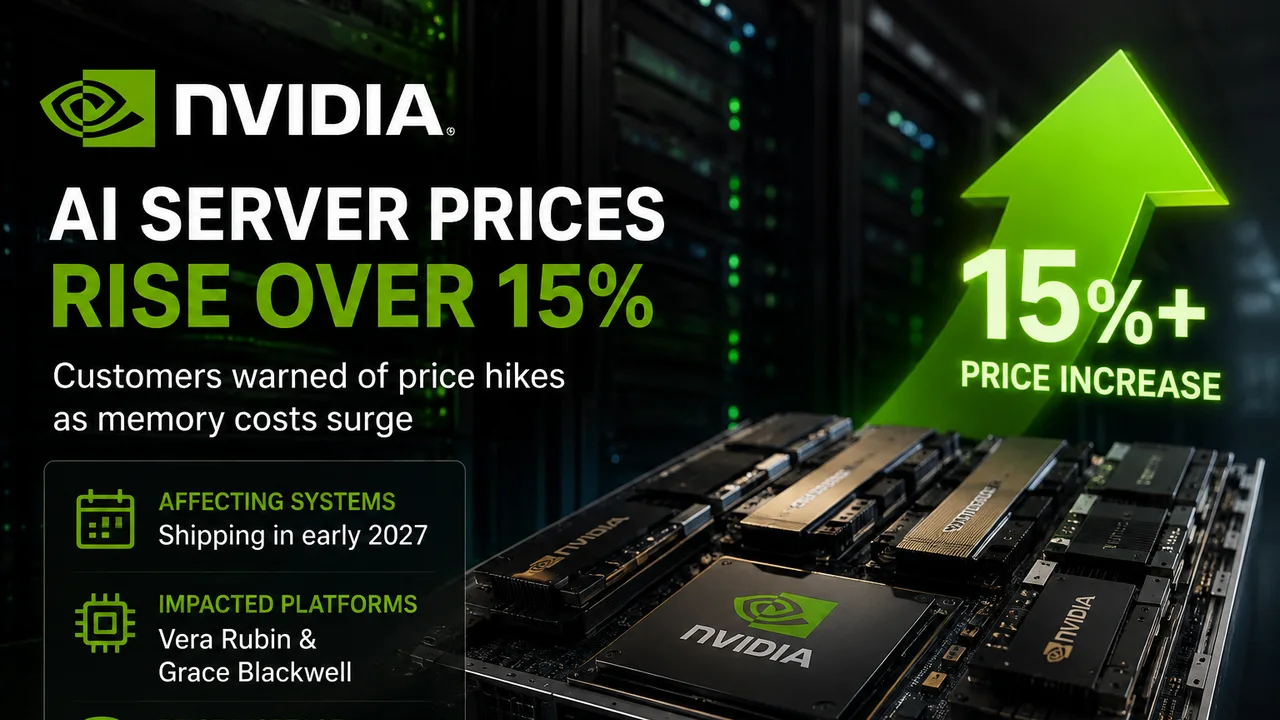
# Nvidia customers reportedly face AI server price hikes above 15%
Nvidia's next generation of artificial intelligence infrastructure could become significantly more expensive, with some of the company's largest customers reportedly being warned that AI server prices may rise by more than 15%.
The increases are expected to affect systems shipped in early 2027 and come as soaring memory costs put new pressure on the already expensive race to build increasingly powerful AI data centers.
According to a Bloomberg News report cited by Reuters, server manufacturers supplying major data center operators have already passed information about the planned price increases to customers.
The size of the increase is expected to vary depending on the generation of Nvidia hardware and the amount and type of memory used in each system.
Nvidia has not publicly confirmed the reported price increases.
## Nvidia's Vera Rubin systems could be affected
The reported increases are particularly notable because they could affect systems based on Nvidia's newest AI architectures, including Vera Rubin and Grace Blackwell.
Vera Rubin represents Nvidia's latest push toward enormous rack-scale AI systems designed for training and running increasingly sophisticated models.
Nvidia's flagship Vera Rubin NVL72 system combines 72 Rubin GPUs with 36 Vera CPUs and uses high-bandwidth HBM4 memory.
A single NVL72 configuration includes 20.7TB of HBM4 memory, according to Nvidia's specifications.
That enormous memory requirement helps explain why changes in advanced memory pricing can have a substantial impact on the cost of a complete AI system.
Modern AI accelerators increasingly depend on high-bandwidth memory to move enormous amounts of data between memory and processors quickly enough to keep powerful GPUs fully utilized.
## Memory is becoming one of AI's biggest bottlenecks
The AI infrastructure boom has created intense demand not only for GPUs but also for the advanced memory and semiconductor capacity surrounding them.
That pressure is now appearing throughout the chip industry.
Reuters recently reported rising high-bandwidth memory prices as AI companies compete for limited supply, while semiconductor manufacturers continue investing heavily to expand next-generation memory production.
The effect is important because an AI server is much more than the Nvidia GPU at its center.
A rack-scale system also requires large quantities of advanced memory, networking hardware, CPUs, power-management components, cooling systems and high-speed interconnects.
When prices increase across even one of those categories, the total cost of deploying thousands of GPUs can rise dramatically.
For hyperscale customers purchasing entire clusters, a double-digit percentage increase could translate into billions of dollars in additional infrastructure spending.
## The timing could matter for Microsoft, Google and Oracle
Reuters reported that server manufacturers supplying major cloud and data center operators including Microsoft, Google and Oracle have communicated the pricing information to customers.
Those companies are among the largest participants in the global AI infrastructure expansion.
They are racing to add computing capacity for AI model training, inference, enterprise applications and cloud services.
Nvidia says its Vera Rubin ecosystem is already being deployed by companies including Microsoft Azure, Google Cloud, Oracle Cloud Infrastructure and CoreWeave.
That means even relatively small changes in the cost of each rack can become significant when deployments expand to tens of thousands of accelerators.
## Nvidia is selling more AI hardware than ever
The reported price increases arrive while Nvidia's data center business continues to grow at extraordinary speed.
For its fiscal 2027 first quarter, Nvidia reported record revenue of $81.6 billion, up 85% from the same period a year earlier.
Data Center revenue alone reached a record $75.2 billion, an increase of 92% year over year.
Those numbers demonstrate just how central AI infrastructure has become to Nvidia's business.
Chief executive Jensen Huang has repeatedly described the global expansion of AI computing infrastructure as the construction of "AI factories," with companies investing heavily in systems capable of producing intelligence at enormous scale.
Vera Rubin is designed specifically for that environment.
Nvidia says the platform can train some mixture-of-experts AI models using one-fourth as many GPUs as its earlier GB200 NVL72 systems.
The company also claims major improvements in inference efficiency and throughput.
Those efficiency improvements could help customers offset some of the higher upfront hardware costs.
But they do not eliminate the broader supply-chain problem.
## AI infrastructure is getting more expensive
Nvidia is not the only company facing pricing pressure.
Samsung recently increased prices for certain advanced chipmaking services by as much as 15% amid heavy demand and constrained semiconductor manufacturing capacity, Reuters reported.
Meanwhile, enormous amounts of capital continue flowing into AI infrastructure.
Cloud providers, chipmakers and AI laboratories are planning increasingly large data centers that require not only GPUs but also electricity generation, networking systems, storage and cooling infrastructure.
That means the economics of AI are beginning to depend on an entire supply chain rather than simply the cost of the accelerator itself.
The reported Nvidia price increase is another sign of that shift.
## All eyes are now on Nvidia's earnings
The timing of the report is particularly interesting because Nvidia is preparing to release its next quarterly results.
The company has officially scheduled its fiscal 2027 second-quarter earnings announcement for August 26, with results expected before its conference call later that day.
Investors will likely be watching closely for any discussion of supply constraints, memory costs, Vera Rubin demand and pricing.
Nvidia has not yet commented publicly on the reported server price increases, so it remains unclear whether the company will address the issue during its earnings call.
For now, however, the report highlights a growing challenge facing the AI industry.
The world's largest technology companies want more computing power than ever before.
Building that computing power is getting more expensive.
Related
IonQ Decodes 408 Logical Qubits in Real Time on One CPU
China's CXMT Starts Mass Production of 11.95nm G5 DRAM
Joby's Autonomous Plane Crosses US in 3,199-Mile Flight
Apple Ships iOS 27 With Siri AI, but Not for EU iPhones
Ternus, Not Cook, Fronts Apple's Sept. 9 Keynote as New CEO
Waymo, Zoox Expand Robotaxis to More US Cities
India plans to let AI agents pay on UPI without each approval
Meta Closes Loophole Letting Smart Glasses Record Covertly
Trending now
- US-China Trade Truce Extended to Jan. 10 as Xi Visits
- Amoeba Breeds at 63°C, Past the 60°C Limit for Complex Life
- 996 Zyxel Switches Looted in 48 Countries; Patch Due Sept. 24
- Oracle Invokes Force Majeure on 2.45GW Stargate Data Center
- Diller Drops $18B MGM Bid; Stock Falls 9.5% to February Levels
- Taylor Swift Adds 4 Songs to ‘Showgirl’ in Sept. 25 Encore
- Attacks on WordPress RCE Flaw Rose Tenfold After Sept. 22 Fix
- Rivian Recalls 98,828 EVs Over Rearview Camera Fault
Comments
No comments yet. Be the first.