YouTube Is Doubling Monetization Thresholds for New Creators in 2027
YouTube is raising the bar for creators who want to start earning money from their videos.
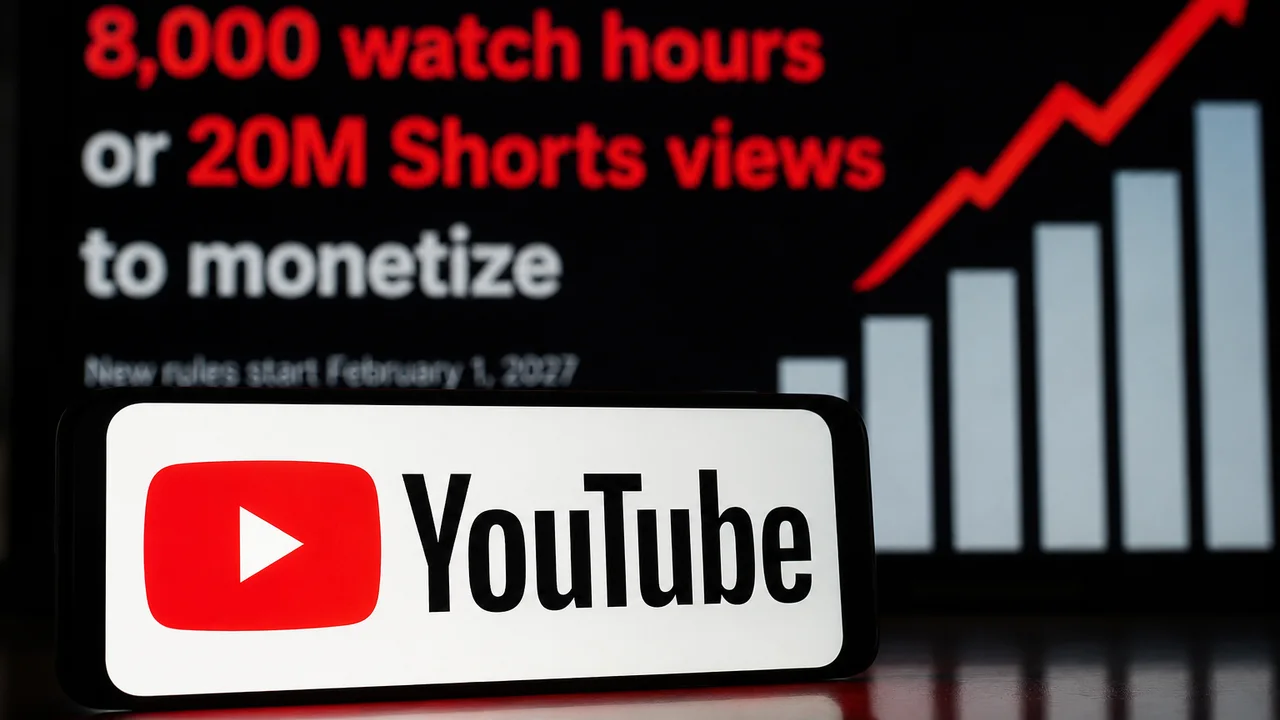
Beginning February 1, 2027, new creators applying for advertising and YouTube Premium revenue sharing through the YouTube Partner Program will need either 8,000 qualified watch hours during the previous 365 days or 20 million qualified Shorts views during the previous 90 days.
The minimum subscriber requirement will remain at 1,000 subscribers.
The change effectively doubles YouTube's current audience thresholds, which require 4,000 valid public watch hours over 12 months or 10 million valid public Shorts views over 90 days alongside 1,000 subscribers.
YouTube's new monetization requirements
For new creators seeking access to ads and Premium revenue sharing, the requirements will change as follows:
Requirement Current From February 1, 2027 Subscribers 1,000 1,000 Long-form watch hours 4,000 8,000 Shorts views 10 million 20 million Shorts measurement period 90 days 90 days Watch-time measurement period 12 months 365 days
YouTube says the changes apply to new creators applying for the revenue-sharing tier of YPP.
Creators who are already members of the YouTube Partner Program will not be forced to meet the new 8,000-hour or 20-million-view entry thresholds.
Existing YouTube creators are not being removed
The announcement does not mean creators who already qualified under the existing requirements will suddenly lose their YPP membership.
YouTube explicitly says the new entry requirements will not affect creators who are already in YPP.
Existing partners will, however, need to review and accept YouTube's updated terms in YouTube Studio by January 31, 2027 to continue fully monetizing their content when the changes take effect the following day.
That distinction is important: YouTube is raising the barrier for future applicants rather than retroactively forcing every existing creator to accumulate another 4,000 hours of watch time.
YouTube Shorts creators face another major change
Shorts creators will also face an ongoing threshold after joining the program.
Starting February 1, channels will need at least 10 million qualified Shorts views over the previous 90 days to participate in Shorts advertising and subscription revenue sharing.
If a channel falls below that level, YouTube says it will remain in the Partner Program and can continue earning revenue from eligible long-form videos.
Shorts revenue sharing will resume automatically if the channel later crosses the 10-million-view threshold again.
This could put greater pressure on Shorts-focused channels to maintain consistent viewing figures instead of relying on a single viral hit.
Why is YouTube changing YPP?
YouTube says the platform has grown dramatically since its monetization requirements were last significantly updated.
The company says YouTube now generates more than 200 billion daily Shorts views, while viewers watch more than one billion hours of YouTube on television screens every day.
Against that backdrop, YouTube says it wants its monetization system to better reward creators generating sustained growth and engagement.
The change is particularly significant because the current 4,000-hour requirement has been one of the best-known milestones for aspiring YouTubers for years.
For a new long-form creator, the new rules mean averaging roughly 667 qualified watch hours per month over a year to reach 8,000 hours.
For Shorts-first channels, reaching 20 million qualified views within 90 days means averaging more than 222,000 views every day.
Some YouTube monetization thresholds are staying the same
Not every part of the Partner Program is becoming harder to access.
YouTube says the entry requirements for its fan funding and shopping products will remain unchanged.
The company is also planning additional creator earning opportunities, including incentives connected to YouTube Shopping, brand deals and creators who start or grow trends on the platform. More details about those programs are expected later.
YouTube Premium Lite is expanding too
The tougher YPP requirements arrive alongside another major change to YouTube's subscription business.
YouTube is expanding Premium Lite to every country where YouTube Premium is available.
YouTube says subscription revenue is distributed to eligible creators according to member watch time and views, with revenue-sharing rates of 55% for long-form videos and 45% for Shorts after the applicable revenue pool is calculated.
For creators, that means YouTube is simultaneously raising the requirements for entering its core revenue-sharing program while expanding other ways for established channels to generate income.
When do the new YouTube monetization rules start?
The changes take effect on February 1, 2027.
Until then, YouTube's existing qualification thresholds remain in place: 1,000 subscribers plus either 4,000 valid public watch hours during the previous 12 months or 10 million valid public Shorts views during the previous 90 days.
For creators who are already close to qualifying for the YouTube Partner Program, that gives the next several months considerably more importance.
Sources
- YouTube Official BlogPrimary source
- YouTube HelpPrimary source
- NewsshooterSecondary
- CineDSecondary
Related
IonQ Decodes 408 Logical Qubits in Real Time on One CPU
China's CXMT Starts Mass Production of 11.95nm G5 DRAM
Joby's Autonomous Plane Crosses US in 3,199-Mile Flight
Apple Ships iOS 27 With Siri AI, but Not for EU iPhones
Ternus, Not Cook, Fronts Apple's Sept. 9 Keynote as New CEO
India plans to let AI agents pay on UPI without each approval
Leaked DLSS 5 runs early — and halves RTX 5070 Ti frame rate
AWS and Nvidia to deploy 2 million more GPUs by 2028
Trending now
- Crew-13 Targets 7-Hour, 50-Minute Trip to the ISS on Oct. 1
- Diller Drops $18B MGM Bid; Stock Falls 9.5% to February Levels
- Hyundai, Kia, Genesis EV Owners Sue Over Twice-Recalled ICCU
- Google Says Gemini Hacked Three Real Companies in May Test
- Zhang Zhanshuo, 19, First Swimmer With 7 Golds at One Asian Games
- Claude AI Formalizes Proof of Fermat's Last Theorem
- JKMax Recalls 195,000 Heated Blankets After 53 Burn Injuries
- Dinosaur Dung Preserves First Known Feathers of a Diving Bird
Comments
No comments yet. Be the first.